
The Indian Peafowl, Pavo cristatus, also known as the Common Peafowl or the Blue Peafowl, is one of the species of bird in the genus Pavo of the Phasianidae family known as peafowl. The Indian Peafowl is a resident breeder in the Indian subcontinent and has been introduced into many parts of the world and feral populations exist in many introduced regions. The peacock is the national bird of India.
Indian Peahen with Immatures at Hodal in Faridabad District of Haryana, India.
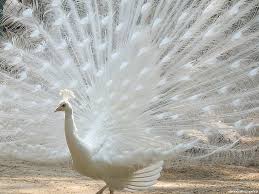
Peacock "tail feathers" are really upper tail coverts.
The species is found in dry semi-desert grasslands, scrub and deciduous forests. It forages and nests on the ground but roosts on top of trees. It eats seeds, insects, fruits, small mammals and reptiles.
Females are about 86 cm (34 in) long and weigh 2.75-4 kg (6-8.8 lbs), while males average at about 2.12 m (7.3 ft) in full breeding plumage (107 cm/42 in when not) and weigh 4-6 kg (8.8-13.2 lbs). The male is called a peacock, the female a peahen. The Indian Peacock has iridescent blue-green plumage. The upper tail coverts on its back are elongated and ornate with an eye at the end of each feather. These are the Peacock's display feathers. The female plumage is a mixture of dull green, grey and iridescent blue, with the greenish-grey predominating. In the breeding season, females stand apart by lacking the long 'tail feathers' also known as train, and in the non-breeding season they can be distinguished from males by the green colour of the neck as opposed to the blue on the males.
Peafowl are most notable for the male's extravagant display feathers which, despite actually growing from their back, are known as a 'tail' or train. This train is in reality not the tail but the enormously elongated upper tail coverts. The tail itself is brown and short as in the peahen. The colours result from the micro-structure of the feathers and the resulting optical phenomena.[1] The ornate train is believed to be the result of female sexual selection as males raised the feathers into a fan and quiver it as part of courtship display. Many studies have suggested that the quality of train is an honest signal of the condition of males and that peahens select males on the basis of their plumage. More recent studies however, suggest that other cues may be involved in mate selection by peahens.[2] [3] [4]
They lay a clutch of 4-8 eggs which take 28 days to hatch. The eggs are light brown and are laid every other day usually in the afternoon. The male does not assist with the rearing, and is polygamous with up to six hens.
Hybridization and concerns
The Indian Peafowl can hybridise with the closely related Green Peafowl, Pavo muticus, in captivity and creates offspring called "Spauldings" or "Spaldings". The original "Spalding" was a hybrid between a female of the Black-Shouldered mutation of the Indian Peafowl, with a male of the nominate Java subspecies of the Green Peafowl, though some believe it was really a cross between a Black-Shouldered male with a Green Peafowl hen of the subspecies imperator.
Even though there is no natural range overlap, hybridization occurs in the wild when feral populations of one of the species overlaps another species. Hybridization has created some concern as the Green Peafowl is endangered.
[edit] The Peacocks in Indian religions and cultures
Yezidi depiction of Melek Taus.
Murugan
Hindu mythology describes the peacock is to be the vahan or the vehicle for Karthikeya also called [Murugan]], the brother of Ganesha, the goddess Saraswati, and the goddess Mahamayuri. The main figure of the Kurdish religion Yezidism, Melek Taus, is most commonly depicted as a peacock. The Yezidi's claim Indian origins.[5]
Indian Peacock (called Mayura in Sanskrit) has enjoyed a fabled place in India since ancient times. In imagery Lord Krishna is always represented wearing a peacock feather tucked in his headband. Peacocks often live in proximity to humans. Ancient kings in India were said to have gardens to raise peacocks where guests were invited to see the famous male peacock dance during the mating season. Due to this close proximity to humans for thousands of years, they have entered ancient Indian stories, songs and poems as symbols of beauty and poise. As the mating season coincides with the onset of monsoon rains and the month of Shravan in the Hindu calendar, many songs of rains have peacock-dance mentioned in them. One possible origins of the name of the famous Maurya dynasty of ancient India is probably derived from the word Mayura as the ancestors of the Mauryas are thought to be peacock-keepers of a royal court in eastern India.
[edit] Poaching
Poaching of peacocks for their feathers and poisoning by feeding on pesticide treated seeds are known threats to wild birds.[6] Methods to identify if feathers have been plucked or have been shed naturally have been developed.[7] The national bird of India is facing extincition despite its poaching being a grave offence. Under the law, collection of tail feathers is allowed only when the bird sheds them.[8]
[edit] Indian Peafowl as pets
In the medieval times, the Mughals of India fell in love with this bird, and started keeping them in their famous gardens. Indian Peafowl can be companion animals but there may be problems with dogs, cats and other pets. They may roam, roost or mess on adjoining property. Peafowl have been called "urban guard dogs" because their distinctive cries can act as a warning of approaching people. Several British stately homes keep peafowl in the grounds.
[edit] Peafowl used as logos
* The American television network NBC has used three variations of a rainbow peacock logo since 1956.
* The national carrier of Sri Lanka, Sri Lankan Airlines uses a Peacock as its company logo.
* The Santa Fe Community College Teaching Zoo uses a peafowl on its logo. It was chosen due to the free roaming peafowl that live on zoo grounds.
[edit] Other Cultural references
* Lord Krishna's Crown always has a peacock's feather.
* According to Greek mythology, the "eyes" on the tail of a peacock were placed there by Hera to commemorate her faithful watchman, Argus who had a hundred eyes (Ovid I, 625).
* In two epic poems of Kalidasa (Meghaduta and Kumarasambhava) the beauty of the peacock has been used as an ornate literary tool.
* The Jataka tales Mahamayur Jataka (491) describing the earlier birth of Bhagavan Buddha describe it in the form of a golden peacock. There is an interesting story about the Golden peacock. Another of these tales record that intrepid Indian traders going as far as Babylon used to take peacocks with them, and had to sell them to the native population on request.
* In the local folktales of India the peacock has a special place. A Punjabi folktale tells of a Queen requesting her husband not to hunt peacocks, saying that the peacock is her brother.
* In the Mayuri subtribe of Bhils in India, women take out their veils whenever they see a peacock and they are worshipped during festivals.

BANANA
Banana is the common name for a type of fruit and also the herbaceous plants of the genus Musa which produce this commonly eaten fruit. They are native to the tropical region of Southeast Asia. Bananas are likely to have been first domesticated in Papua New Guinea.[1] Today, they are cultivated throughout the tropics.
javascript:void(0)
Banana plants are of the family Musaceae. They are cultivated primarily for their fruit, and to a lesser extent for the production of fibre and as ornamental plants. As the banana plants are normally tall and fairly sturdy they are often mistaken for trees, but their main or upright stem is actually a pseudostem (literally "fake stem"). For some species this pseudostem can reach a height of up to 2–8 m, with leaves of up to 3.5 m in length. Each pseudostem can produce a bunch of yellow, green or even red bananas before dying and being replaced by another pseudostem.
The banana fruit grow in hanging clusters, with up to 20 fruit to a tier (called a hand), and 3–20 tiers to a bunch. The total of the hanging clusters is known as a bunch, or commercially as a "banana stem", and can weigh from 30–50 kg. The fruit averages 125 g, of which approximately 75% is water and 25% dry matter content. Each individual fruit (known as a banana or 'finger') has a protective outer layer (a peel or skin) with a fleshy edible inner portion. Both skin and inner part can be eaten raw or cooked. Western cultures generally eat the inside raw and throw away the skin while some Asian cultures generally eat both the skin and inside cooked. Typically, the fruit has numerous strings (called 'phloem bundles') which run between the skin and inner part. Bananas are a valuable source of vitamin B6, vitamin C, and potassium.
Bananas are grown in at least 107 countries.[3] In popular culture and commerce, "banana" usually refers to soft, sweet "dessert" bananas. The bananas from a group of cultivars with firmer, starchier fruit are called plantains. Bananas may also be cut and dried and eaten as a type of chip. Dried bananas are also ground into banana flour.
Although the wild species have fruits with numerous large, hard seeds, virtually all culinary bananas have seedless fruits. Bananas are classified either as dessert bananas (meaning they are yellow and fully ripe when eaten) or as green cooking bananas. Almost all export bananas are of the dessert types; however, only about 10–15% of all production is for export, with the United States and European Union being the dominant buyers.
Botany
This section requires expansion.
The banana plant is a pseudostem that grows to 6 to 7.6 metres (20–25 feet) tall, growing from a corm. Leaves are spirally arranged and may grow 2.7 metres (9 ft) long and 60 cm (2 ft) wide.[4] The banana plant is the largest of all herbaceous flowering plants.[5] The large leaves grow whole, but are easily torn by the wind, resulting in the familiar frond look.
A single, sterile, male banana flower, also known as the banana heart is normally produced by each stem (though on rare occasions more can be produced—a single plant in the Philippines has five[7]). Banana hearts are used as a vegetable in Southeast Asia, steamed, in salads, or eaten raw.[8] The female flowers are produced further up the stem and produce the actual fruit without requiring fertilization. The fruit has been described as a "leathery berry".[9] In cultivated varieties, the seeds have degenerated nearly to non-existence; their remnants are tiny black specks in the interior of the fruit. The ovary is inferior to the flower; because of their stiff stems and the positioning of the ovary and flower, bananas grow sticking up, not hanging down.
Some sources assert that the genus of the banana, Musa, is named for Antonio Musa, physician to the Emperor Augustus.[10] Others say that Linnaeus, who gave the genus its name in 1750, simply adapted an Arabic word for banana, mauz.[11] The word banana itself comes from the Arabic word banan, which means "finger".[11] The genus contains numerous species; several produce edible fruit, while others are cultivated as ornamentals.
Properties
Banana, raw, edible parts
Nutritional value per 100 g (3.5 oz)
Energy 90 kcal 370 kJ
Carbohydrates 22.84 g
- Sugars 12.23 g
- Dietary fiber 2.6 g
Fat 0.33 g
Protein 1.09 g
Vitamin A equiv. 3 μg 0%
Thiamine (Vit. B1) 0.031 mg 2%
Riboflavin (Vit. B2) 0.073 mg 5%
Niacin (Vit. B3) 0.665 mg 4%
Pantothenic acid (B5) 0.334 mg 7%
Vitamin B6 0.367 mg 28%
Folate (Vit. B9) 20 μg 5%
Vitamin C 8.7 mg 15%
Calcium 5 mg 1%
Iron 0.26 mg 2%
Magnesium 27 mg 7%
Phosphorus 22 mg 3%
Potassium 358 mg 8%
Zinc 0.15 mg 1%
One banana is 100–150 g.
Percentages are relative to US
recommendations for adults.
Source: USDA Nutrient database
Bananas come in a variety of sizes and colors when ripe, including yellow, purple, and red. Bananas can be eaten raw though some varieties are generally cooked first. Depending upon cultivar and ripeness, the flesh can vary in taste from starchy to sweet, and texture from firm to mushy. Unripe or green bananas and plantains are used for cooking various dishes such as banana pudding and are the staple starch of many tropical populations. Banana sap is extremely sticky and can be used as a practical adhesive. Sap can be obtained from the pseudostem, from the fruit peelings, or from the fruit flesh.
Most production for local sale is of green cooking bananas and plantains, as ripe dessert bananas are easily damaged while being transported to market. Even when transported only within their country of origin, ripe bananas suffer a high rate of damage and loss.[citation needed]
The commercial dessert cultivars most commonly eaten in temperate countries (species Musa acuminata or the hybrid Musa × paradisiaca, a cultigen) are imported in large quantities from the tropics. They are popular in part because, being a non-seasonal crop, they are available fresh year-round. In global commerce, by far the most important of these banana cultivars is 'Cavendish', which accounts for the vast bulk of bananas exported from the tropics. The Cavendish gained popularity in the 1950s after the previously mass produced cultivar, Gros Michel, became commercially unviable due to Panama disease, a fungus which attacks the roots of the banana plant.
The most important properties making 'Cavendish' the main export banana are related to transport and shelf life rather than taste; major commercial cultivars rarely have a superior flavor[citation needed] compared to the less widespread cultivars. Export bananas are picked green, and then usually ripened in ripening rooms when they arrive in their country of destination. These are special rooms made air-tight and filled with ethylene gas to induce ripening. Bananas can be ordered by the retailer "ungassed", however, and may show up at the supermarket still fully green. While these bananas will ripen more slowly, the flavor will be notably richer[citation needed], and the banana peel can be allowed to reach a yellow/brown speckled phase, and yet retain a firm flesh inside. Thus, shelf life is somewhat extended.
The vivid yellow color normally associated with supermarket bananas is in fact a side-effect of the artificial ripening process. Cavendish bananas that have been allowed to ripen naturally on the plant have a greenish-yellow appearance which changes to a brownish-yellow as they ripen further. Although both the flavor and texture of "tree ripened" bananas is generally regarded as superior to any type green-picked fruit, once natural ripening has commenced the shelf life is typically only 7–10 days, making commercial distribution impractical. For most people the only practical means of obtaining such fruit is growing it themselves, however this is also somewhat problematic, as the bananas all tend to ripen at once and have very poor keeping properties.
The flavor and texture of bananas are also affected by the temperature at which they ripen. Bananas are refrigerated to between 13.5 and 15 °C (57 and 59 °F) during transportation. At lower temperatures, the ripening of bananas permanently stalls, and the bananas will eventually turn gray as cell walls break down. The skins of ripe bananas will quickly turn black in the 4°C environment of a domestic refrigerator, although the fruit inside remains unaffected.
It should be noted that Musa × paradisiaca is also the generic name for the common plantain, a coarser and starchier variant not to be confused with Musa acuminata or the Cavendish variety.
M. acuminata x balbisiana inflorescence, partially opened.
In addition to the fruit, the flower of the banana plant (also known as banana blossom or banana heart) is used in Southeast Asian, Tamil, Bengali, and Kerala (India) cuisine, either served raw with dips or cooked in soups and curries. The tender core of the banana plant's trunk is also used in Bengali and Kerala cooking, and notably in the Burmese dish mohinga. Bananas fried with batter is a popular dessert in Malaysia, Singapore, and Indonesia. Banana fritters can be served with ice cream as well. Bananas are also eaten deep fried, baked in their skin in a split bamboo, or steamed in glutinous rice wrapped in a banana leaf in Burma where bunches of green bananas surrounding a green coconut in a tray form an important part of traditional offerings to the Buddha and the Nats. The juice extract prepared from the tender core is used to treat kidney stones.
The leaves of the banana plant are large, flexible, and waterproof. They are used many ways, including as umbrellas and to wrap food for cooking or storage.[13] Banana leaves are also used to serve food in India and other Asian countries.
Banana chips are a snack produced from dehydrated or fried banana or plantain slices, which have a dark brown color and an intense banana taste. Bananas have also been used in the making of jam. Unlike other fruits, it is difficult to extract juice from bananas because when compressed a banana simply turns to pulp.
Seeded bananas (Musa balbisiana), the forerunner of the common domesticated banana,[14] are sold in markets in Indonesia.
In India, juice is extracted from the corm and used as a home remedy for the treatment of jaundice, sometimes with the addition of honey.[15]
Ripened bananas (left, under sunlight) fluoresce in blue when exposed to UV light.
A 2008 study reported that ripe bananas exhibit a blue fluorescence when exposed to ultraviolet light. This property is attributed to the degradation of chlorophyll giving rise to the accumulation of a fluorescent product in the skin of the fruit. The chlorophyll breakdown product is stabilized by a propionate ester group. Banana-tree leaves also fluoresce in the same way. Green bananas do not show any sign of fluorescence. The study suggested that this allows animals which are capable of seeing in the ultraviolet spectrum to detect ripened bananas.[16]
Trade
This section does not cite any references or sources. Please help improve this article by adding citations to reliable sources (ideally, using inline citations). Unsourced material may be challenged and removed. (October 2008)
Top Banana Producing Nations - 2005
(in million metric tons)
India 16.8
Brazil 6.7
China 6.4
Ecuador 5.9
Philippines 5.8
Indonesia 4.5
Costa Rica 2.2
Mexico 2.0
Thailand 2.0
Colombia 1.6
Burundi 1.6
World Total 72.5
Source: Food and Agriculture Organization of the United Nations[3]
Bananas and plantains constitute a major staple food crop for millions of people in developing countries. In most tropical countries, green (unripe) bananas used for cooking represent the main cultivars. Cooking bananas are very similar to potatoes in how they are used. Both can be fried, boiled, baked, or chipped and have similar taste and texture when served. One green cooking banana has about the same calorie content as one potato.[17]
In 2003, India led the world in banana production, representing approximately 23% of the worldwide crop, most of which was for domestic consumption. The four leading banana exporting countries were Ecuador, Costa Rica, the Philippines, and Colombia, which together accounted for about two-thirds of the world's exports, each exporting more than 1 million tons. Ecuador alone provided more than 30% of global banana exports, according to FAO statistics.
The vast majority of producers are small-scale farmers growing the crop either for home consumption or for local markets. Because bananas and plantains will produce fruit year-round, they provide an extremely valuable source of food during the hunger season (that period of time when all the food from the previous harvest has been consumed, and the next harvest is still some time away). It is for these reasons that bananas and plantains are of major importance to food security.
Women in Belize sorting bananas and cutting them from bunches.
Bananas are among the most widely consumed foods in the world. Most banana farmers receive a low unit price for their produce as supermarkets buy enormous quantities and receive a discount for that business. Competition amongst supermarkets has led to reduced margins in recent years which in turn has led to lower prices for growers. Chiquita, Del Monte, Dole, and Fyffes grow their own bananas in Ecuador, Colombia, Costa Rica, Guatemala, and Honduras. Banana plantations are capital intensive and demand high expertise, so the majority of independent growers are large and wealthy landowners of these countries. This has led to bananas being available as a "fair trade" or Rainforest Alliance certified item in some countries.
The banana has an extensive trade history beginning with the founding of the United Fruit Company (now Chiquita) at the end of the nineteenth century. For much of the 20th century, bananas and coffee dominated the export economies of Central America. In the 1930s, bananas and coffee made up as much as 75% of the region's exports. As late as 1960, the two crops accounted for 67% of the exports from the region. Though the two were grown in similar regions, they tended not to be distributed together. The United Fruit Company based its business almost entirely on the banana trade, as the coffee trade proved too difficult for it to control. The term "banana republic" has been broadly applied to most countries in Central America, but from a strict economic perspective only Costa Rica, Honduras, and Panama were actual "banana republics", countries with economies dominated by the banana trade.
Banana output in 2005
The countries of the European Union have traditionally imported many of their bananas from the former European island colonies of the Caribbean, paying guaranteed prices above global market rates. As of 2005, these arrangements were in the process of being withdrawn under pressure from other major trading powers, principally the United States. The withdrawal of these indirect subsidies to Caribbean producers is expected to favour the banana producers of Central America, in which American companies have an economic interest.
The United States has minimal banana production. 14,000 tons of bananas were grown in Hawaii in 2001.[18] Bananas have also been grown in Florida and southern California.[19]
History
Early cultivation
The domestication of bananas took place in southeastern Asia. Many species of wild bananas still exist in New Guinea, Malaysia, Indonesia, and the Philippines. Recent archaeological and palaeoenvironmental evidence at Kuk Swamp in the Western Highlands Province of Papua New Guinea suggests that banana cultivation there goes back to at least 5000 BCE, and possibly to 8000 BCE.[1] This would make the New Guinean highlands the place where bananas were first domesticated. It is likely that other species of wild bananas were later also domesticated elsewhere in southeastern Asia. Southeast Asia is the region of primary diversity of the banana. Areas of secondary diversity are found in Africa, indicating a long history of banana cultivation in the region.
Actual and probable diffusion of bananas during Islamic times (700–1500 AD)[20]
Some recent discoveries of banana phytoliths in Cameroon dating to the first millennium BCE[21] have triggered an as yet unresolved debate about the antiquity of banana cultivation in Africa. There is linguistic evidence that bananas were already known in Madagascar around that time.[22] The earliest evidence of banana cultivation in Africa before these recent discoveries dates to no earlier than late 6th century AD.[23] In this view, bananas were introduced to the east coast of Africa by Muslim Arabs.[20]
The banana may have been present in isolated locations of the Middle East on the eve of the rise of Islam. There is some textual evidence that the prophet Muhammad was familiar with it. The spread of Islam was followed by the far reaching diffusion of bananas. There are numerous references to it in Islamic texts (such as poems and hadiths) beginning in the ninth century. By the tenth century the banana appears in texts from Palestine and Egypt. From there it diffused into north Africa and Muslim Spain. In fact, during the medieval ages, bananas from Granada were considered amongst the best in the Arab world.[20] In 650, Islamic conquerors brought the banana to Palestine.
Bananas were introduced to the Americas by Portuguese sailors who brought the fruits from West Africa in the 1500s.[24] The word banana is of West African origin, and passed into English via Spanish or Portuguese.[25]
Plantation cultivation
In the 15th and 16th century, Portuguese colonists started banana plantations in the Atlantic Islands, Brazil, and western Africa.[26] As late as the Victorian Era, bananas were not widely known in Europe, although they were available via merchant trade.[26] Jules Verne references bananas with detailed descriptions so as not to confuse readers in his book Around the World in Eighty Days (1872).
In the early 20th century, bananas began forming the basis of large commercial empires, exemplarized by the United Fruit Company, which created immense banana plantations especially in Central and South America. These were usually extremely commercially exploitative, and the term "Banana republic" was coined for states like Honduras and Guatemala, representing the fact that "servile dictatorships" were created and abetted by these companies and their political backers, for example in the USA.[27]
Cultivation
This section does not cite any references or sources. Please help improve this article by adding citations to reliable sources (ideally, using inline citations). Unsourced material may be challenged and removed. (October 2008)
Fruits of wild-type bananas have numerous large, hard seeds.
Banana corms, used in the propagation of domesticated bananas.
While the original bananas contained rather large seeds, triploid (and thus seedless) cultivars have been selected for human consumption. These are propagated asexually from offshoots of the plant. The plant is allowed to produce 2 shoots at a time; a larger one for fruiting immediately and a smaller "sucker" or "follower" that will produce fruit in 6–8 months time. The life of a banana plantation is 25 years or longer, during which time the individual stools or planting sites may move slightly from their original positions as lateral rhizome formation dictates.
Cultivated bananas are parthenocarpic, which makes them sterile and unable to produce viable seeds. Lacking seeds, another form of propagation is required. This normally involves removing and transplanting part of the underground stem (called a corm). Usually this is done by carefully removing a sucker (a vertical shoot that develops from the base of the banana pseudostem) with some roots intact. However, small sympodial corms, representing not yet elongated suckers, are easier to transplant and can be left out of the ground for up to 2 weeks; they require minimal care and can be boxed together for shipment.
Contrary to what is widely believed, it is not actually necessary to include any of the corm or root structure to propagate bananas; severed suckers with no root material attached can be successfully propagated in damp sand, although this takes somewhat longer.
In some countries, bananas are also commercially propagated by means of tissue culture. This method is preferred since it ensures disease-free planting material. When using vegetative parts such as suckers for propagation, there is a risk of transmitting diseases (especially the devastating Panama disease).
Pests, diseases, and natural disasters
Main article: List of banana and plantain diseases
Banana bunches are sometimes encased in plastic bags for protection. The bags may be coated with pesticides.
Inspecting bananas for fruit flies
While in no danger of outright extinction, the most common edible banana cultivar 'Cavendish' (extremely popular in Europe and the Americas) could become unviable for large-scale cultivation in the next 10–20 years. Its predecessor 'Gros Michel', discovered in the 1820s, has already suffered this fate. Like almost all bananas, it lacks genetic diversity, which makes it vulnerable to diseases, which threaten both commercial cultivation and the small-scale subsistence farming.[28][29] Some commentators have further remarked that those variants which could replace what much of the world considers a "typical banana" are so different that most people would not consider them the same fruit, and blame the decline of the banana on monogenetic cultivation driven by short-term commercial exploitation motives.[27]
Major diseases
This section does not cite any references or sources. Please help improve this article by adding citations to reliable sources (ideally, using inline citations). Unsourced material may be challenged and removed. (October 2008)
Major afflictions of bananas include:
* Panama Disease (Race 1): fusarium wilt (a soil fungus). The fungus enters the plants through the roots and moves up with water into the trunk and leaves, producing gels and gums. These plug and cut off the flow of water and nutrients, causing the plant to wilt. Prior to 1960 almost all commercial banana production centered on the cultivar 'Gros Michel', which was highly susceptible to fusarium wilt and collapse, exposing the rest of the plant to lethal amounts of sunlight.[30] The cultivar 'Cavendish' was chosen as a replacement for 'Gros Michel' because out of the resistant cultivars it was viewed as producing the highest quality fruit. However, more care is required for shipping the 'Cavendish' banana, and its quality compared to 'Gros Michel' is debated.
However, according to current references, a deadly form of Panama disease is infecting the world's Cavendish banana plants. All are genetically identical, which causes problems when it comes to disease resistance. However, researchers are experimenting with hundreds of feral varieties to find out which one(s) are resistant.[30]
* Tropical Race 4: a reinvigorated strain of Panama disease first discovered in 1993. This is a virulent form of fusarium wilt that has wiped out 'Cavendish' in several southeast Asian countries. It has yet to reach the Americas; however, soil fungi can easily be carried on boots, clothing, or tools. This is how Tropical Race 4 moves from one plantation to another and is its most likely route into Latin America. The Cavendish cultivar is highly susceptible to TR4, and over time, Cavendish is almost certain to be eliminated from commercial production by this disease. Unfortunately, the only known defense to TR4 is genetic resistance.
* Black Sigatoka: a fungal leaf spot disease first observed in Fiji in 1963 or 1964. Black Sigatoka (also known as Black Leaf Streak) has spread to banana plantations throughout the tropics due to infected banana leaves being used as packing material. It affects all of the main cultivars of bananas and plantains, impeding photosynthesis by turning parts of their leaves black, and eventually killing the entire leaf. Being starved for energy, fruit production falls by 50% or more, and the bananas that do grow suffer premature ripening, making them unsuitable for export. The fungus has shown ever increasing resistance to fungicidal treatment, with the current expense for treating 1 hectare exceeding $1000 per year. In addition to the financial expense there is the question of how long such intensive spraying can be justified environmentally. Several resistant cultivars of banana have been developed, but none has yet received wide scale commercial acceptance due to taste and texture issues.
* Banana Bunchy Top Virus (BBTV): this virus is spread from plant to plant by aphids. It causes stunting of the leaves resulting in a "bunched" appearance. Generally, a banana plant infected with the virus will not set fruit, although mild strains exist in many areas which do allow for some fruit production. These mild strains are often mistaken for malnourishment, or a disease other than BBTV. There is no cure for BBTV, however its effect can be minimised by planting only tissue cultured plants (In-vitro propagation), controlling the aphids, and immediately removing and destroying any plant from the field that shows signs of the disease.
Even though it is no longer viable for large scale cultivation, 'Gros Michel' is not extinct and is still grown in areas where Panama disease is not found. Likewise, "Cavendish" is in no danger of extinction, but it may leave the shelves of the supermarkets for good if diseases make it impossible to supply the global market. It is unclear if any existing cultivar can replace 'Cavendish' on a scale needed to fill current demand, so various hybridisation and genetic engineering programs are working on creating a disease-resistant, mass-market banana.
In Australia
Banana trees destroyed after Cyclone Larry in 2006
Australia is relatively free of plant diseases and therefore prohibits imports. When Cyclone Larry wiped out Australia's domestic banana crop in 2006, bananas became relatively expensive, due to both low supply domestically and the existence of laws prohibiting banana imports. Prices have since fallen as production has reverted back to a steady rate.
In East Africa
Most bananas grown worldwide are used for local consumption. In the tropics, bananas, especially cooking bananas, represent a major source of food, as well as a major source of income for smallholder farmers. It is in the East African highlands that bananas reach their greatest importance as a staple food crop. In countries such as Uganda, Burundi, and Rwanda per capita consumption has been estimated at 450 kg per year, the highest in the world. Ugandans use the same word "matooke" to describe both banana and food.
In the past, the banana was a highly sustainable crop with a long plantation life and stable yields year round. However with the arrival of the Black sigatoka fungus, banana production in eastern Africa has fallen by over 40%. For example, during the 1970s, Uganda produced 15 to 20 tonnes of bananas per hectare. Today, production has fallen to only 6 tonnes per hectare.
The situation has started to improve as new disease resistant cultivars have been developed by the International Institute of Tropical Agriculture and NARO such as the FHIA-17 (known in Uganda as the Kabana 3). These new cultivars taste different from the traditionally grown banana which has slowed their acceptance by local farmers. However, by adding mulch and animal manure to the soil around the base of the banana plant, these new cultivars have substantially increased yields in the areas where they have been tried.
The International Institute of Tropical Agriculture and NARO, funded by the Rockefeller Foundation and CGIAR have started trials for genetically modified banana plants that are resistant to both Black sigatoka and banana weevils. It is developing cultivars specifically for smallholder or subsistence farmers.
Health benefits
Potential health benefits of banana consumption.[31][32]
By a high potassium to sodium content, bananas may prevent high blood pressure and its complications.[31][32] High fiber content may also contribute to this effect.[31] High potassium may also prevent renal calcium loss, in effect preventing bone breakdown.[31] In diarrhea, it contributes with electrolyte replacement, as well as increased absorption of nutrients.[31] Bananas also have some antacid effect, protecting from peptic ulcers.[31] [32] Pectin content, a hydrocolloid, can ease constipation by normalizing movement through the intestine.[31] The low glycemic index in unripe bananas is of particular benefit to people with diabetes.[31][32] High fructooligosaccharide content may work as a prebiotic, nourishing the intestinal flora to produce beneficial vitamins and enzymes.[31] Carotenoid content has antioxidant effects, and protects against vitamin A deficiency, resulting in e.g. night blindness.[31] Moderate consumption decreases risk of kidney cancer, possibly due to antioxidant phenolic compounds.[31] In contrast, large consumption of highly processed fruit juice increases the risk of kidney cancer.[31]
Fruit consumption in general decreases the risk of age-related macular degeneration.[31]
Allergic reactions
There are two forms of banana allergy. One is oral allergy syndrome which causes itching and swelling in the mouth or throat within one hour after ingestion and is related to birch tree and other pollen allergies. The other is related to latex allergies and causes urticaria and potentially serious upper gastrointestinal symptoms.[33]
Fibre
Textiles
The banana plant has long been a source of fibre for high quality textiles. In Japan, the cultivation of banana for clothing and household use dates back to at least the 13th century. In the Japanese system, leaves and shoots are cut from the plant periodically to ensure softness. The harvested shoots must first be boiled in lye to prepare the fibres for the making of the yarn. These banana shoots produce fibres of varying degrees of softness, yielding yarns and textiles with differing qualities for specific uses. For example, the outermost fibres of the shoots are the coarsest, and are suitable for tablecloths, whereas the softest innermost fibres are desirable for kimono and kamishimo. This traditional Japanese banana cloth making process requires many steps, all performed by hand.[34]
In another system employed in Nepal, the trunk of the banana plant is harvested instead, small pieces of which are subjected to a softening process, mechanical extraction of the fibres, bleaching, and drying. After that, the fibres are sent to the Kathmandu Valley for the making of high end rugs with a textural quality similar to silk. These banana fibre rugs are woven by the traditional Nepalese hand-knotted methods, and are sold RugMark certified.
Paper
Main article: Banana paper
Banana fibre is also used in the production of banana paper. Banana paper is used in two different senses: to refer to a paper made from the bark of the banana plant, mainly used for artistic purposes, or paper made from banana fiber, obtained from an industrialized process, from the stem and the non usable fruits. This paper can be either hand-made or made by industrialized machine.
Storage and transport
Banana storage room, Salt Lake City, 1913
In the current world marketing system, bananas are grown in the tropics. The fruit therefore has to be transported over long distances and storage is necessary. To gain maximum life, bunches are harvested before the fruit is fully mature. The fruit is carefully handled, transported quickly to the seaboard, cooled, and shipped under sophisticated refrigeration. The basis of this procedure is to prevent the bananas producing ethylene which is the natural ripening agent of the fruit. This sophisticated technology allows storage and transport for 3–4 weeks at 13 degrees Celsius. On arrival at the destination, the bananas are held at about 17 degrees Celsius and treated with a low concentration of ethylene. After a few days, the fruit has begun to ripen and it is distributed for retail sale. It is important to note that unripe bananas can not be held in the home refrigerator as they suffer from the cold. After ripening some bananas can be held for a few days at home. They can be stored indefinitely frozen, then eaten like an ice pop or cooked as a banana mush.
Recent studies have suggested[35][36][37] that the presence of carbon dioxide (which is produced by the fruit) extends the life and the addition of an ethylene absorbent further extends the life even at high temperatures. This effect can be exploited by packing the fruit in a polyethylene bag and including an ethylene absorbent, potassium permanganate, on an inert carrier. The bag is then sealed with a band or string. This treatment has been shown to more than double the life of the bananas at a range of temperatures and can give a life of up to 3–4 weeks without the need for refrigeration.
Usage in culture
Peels
The depiction of a person slipping on a banana peel has been a staple of physical comedy for generations. A 1906 comedy record produced by Edison Records features a popular character of the time, "Cal Stewart", claiming to describe his own such incident, saying:
I don't think much of a man what throws a banana peeling on the sidewalk, and I don't think much of a bananer what throws a man on the sidewalk, neither. ... my foot hit that bananer peelin' and I went up in the air, and come down ker-plunk, and fer about a minnit I seen all the stars what 'stronomy tells about, and some that hain't been discovered yit. Wall jist as I was pickin' myself up, a little boy come runnin' cross the street and he said, "Oh mister, won't you please do that agin? My mother didn't see you do it."
Arts
* The poet Bashō is named after the Japanese word for a banana plant. The "bashō" planted in his garden by a grateful student became a source of inspiration to his poetry, as well as a symbol of his life and home.[38]
* The song Yes! We Have No Bananas was written by Frank Silver and Irving Cohn and originally released in 1923; for many decades, it was the best-selling sheet music in history. Since then the song has been rerecorded several times and has been particularly popular during banana shortages.
Symbols
Bananas are also humorously used as a phallic symbol due to similarities in size and shape. This is typified by the artwork of the debut album of The Velvet Underground, which features a banana on the front cover, yet on the original LP version, the design allowed the listener to 'peel' this banana to find a pink, phallic structure on the inside.
Gallery
Traditional offerings of bananas and coconut at a Nat spirit shrine in Myanmar.
Certain banana cultivars turn red or purplish instead of yellow as they ripen.
Bananas are often sold in bunches, as shown above.
A bunch of bananas.
Banana pudding.
Banana plant, Luxor, Egypt - Bananas are continually cropped, fruits from higher in the inflorescence being taken before the lower part opens.
Banana plant.
From the left: bananas as commonly eaten by peeling the skin in thick strips; banana fruit; banana cross section.
See also
* Banana production in Iceland
* Banana messenger
* Bananadine
* Banana republic
* Enset (false banana)
* Plantain
* Banana Pancake Trail
* Banana boat
* Song: Yes! We Have No Bananas
* Song: Day-O (The Banana Boat Song)
Culinary usage
* Banana beer
* Banana bread
* Banana chips
* Bananas Foster
* Banana ketchup
* Banana pudding
* Banana sauce
* Banana split
* Banania
* Bánh chuối
* Cream pie
* Pisang goreng
* Tonto (beverage)
javascript:void(0)
Banana plants are of the family Musaceae. They are cultivated primarily for their fruit, and to a lesser extent for the production of fibre and as ornamental plants. As the banana plants are normally tall and fairly sturdy they are often mistaken for trees, but their main or upright stem is actually a pseudostem (literally "fake stem"). For some species this pseudostem can reach a height of up to 2–8 m, with leaves of up to 3.5 m in length. Each pseudostem can produce a bunch of yellow, green or even red bananas before dying and being replaced by another pseudostem.
The banana fruit grow in hanging clusters, with up to 20 fruit to a tier (called a hand), and 3–20 tiers to a bunch. The total of the hanging clusters is known as a bunch, or commercially as a "banana stem", and can weigh from 30–50 kg. The fruit averages 125 g, of which approximately 75% is water and 25% dry matter content. Each individual fruit (known as a banana or 'finger') has a protective outer layer (a peel or skin) with a fleshy edible inner portion. Both skin and inner part can be eaten raw or cooked. Western cultures generally eat the inside raw and throw away the skin while some Asian cultures generally eat both the skin and inside cooked. Typically, the fruit has numerous strings (called 'phloem bundles') which run between the skin and inner part. Bananas are a valuable source of vitamin B6, vitamin C, and potassium.
Bananas are grown in at least 107 countries.[3] In popular culture and commerce, "banana" usually refers to soft, sweet "dessert" bananas. The bananas from a group of cultivars with firmer, starchier fruit are called plantains. Bananas may also be cut and dried and eaten as a type of chip. Dried bananas are also ground into banana flour.
Although the wild species have fruits with numerous large, hard seeds, virtually all culinary bananas have seedless fruits. Bananas are classified either as dessert bananas (meaning they are yellow and fully ripe when eaten) or as green cooking bananas. Almost all export bananas are of the dessert types; however, only about 10–15% of all production is for export, with the United States and European Union being the dominant buyers.
Botany
This section requires expansion.
The banana plant is a pseudostem that grows to 6 to 7.6 metres (20–25 feet) tall, growing from a corm. Leaves are spirally arranged and may grow 2.7 metres (9 ft) long and 60 cm (2 ft) wide.[4] The banana plant is the largest of all herbaceous flowering plants.[5] The large leaves grow whole, but are easily torn by the wind, resulting in the familiar frond look.
A single, sterile, male banana flower, also known as the banana heart is normally produced by each stem (though on rare occasions more can be produced—a single plant in the Philippines has five[7]). Banana hearts are used as a vegetable in Southeast Asia, steamed, in salads, or eaten raw.[8] The female flowers are produced further up the stem and produce the actual fruit without requiring fertilization. The fruit has been described as a "leathery berry".[9] In cultivated varieties, the seeds have degenerated nearly to non-existence; their remnants are tiny black specks in the interior of the fruit. The ovary is inferior to the flower; because of their stiff stems and the positioning of the ovary and flower, bananas grow sticking up, not hanging down.
Some sources assert that the genus of the banana, Musa, is named for Antonio Musa, physician to the Emperor Augustus.[10] Others say that Linnaeus, who gave the genus its name in 1750, simply adapted an Arabic word for banana, mauz.[11] The word banana itself comes from the Arabic word banan, which means "finger".[11] The genus contains numerous species; several produce edible fruit, while others are cultivated as ornamentals.
Properties
Banana, raw, edible parts
Nutritional value per 100 g (3.5 oz)
Energy 90 kcal 370 kJ
Carbohydrates 22.84 g
- Sugars 12.23 g
- Dietary fiber 2.6 g
Fat 0.33 g
Protein 1.09 g
Vitamin A equiv. 3 μg 0%
Thiamine (Vit. B1) 0.031 mg 2%
Riboflavin (Vit. B2) 0.073 mg 5%
Niacin (Vit. B3) 0.665 mg 4%
Pantothenic acid (B5) 0.334 mg 7%
Vitamin B6 0.367 mg 28%
Folate (Vit. B9) 20 μg 5%
Vitamin C 8.7 mg 15%
Calcium 5 mg 1%
Iron 0.26 mg 2%
Magnesium 27 mg 7%
Phosphorus 22 mg 3%
Potassium 358 mg 8%
Zinc 0.15 mg 1%
One banana is 100–150 g.
Percentages are relative to US
recommendations for adults.
Source: USDA Nutrient database
Bananas come in a variety of sizes and colors when ripe, including yellow, purple, and red. Bananas can be eaten raw though some varieties are generally cooked first. Depending upon cultivar and ripeness, the flesh can vary in taste from starchy to sweet, and texture from firm to mushy. Unripe or green bananas and plantains are used for cooking various dishes such as banana pudding and are the staple starch of many tropical populations. Banana sap is extremely sticky and can be used as a practical adhesive. Sap can be obtained from the pseudostem, from the fruit peelings, or from the fruit flesh.
Most production for local sale is of green cooking bananas and plantains, as ripe dessert bananas are easily damaged while being transported to market. Even when transported only within their country of origin, ripe bananas suffer a high rate of damage and loss.[citation needed]
The commercial dessert cultivars most commonly eaten in temperate countries (species Musa acuminata or the hybrid Musa × paradisiaca, a cultigen) are imported in large quantities from the tropics. They are popular in part because, being a non-seasonal crop, they are available fresh year-round. In global commerce, by far the most important of these banana cultivars is 'Cavendish', which accounts for the vast bulk of bananas exported from the tropics. The Cavendish gained popularity in the 1950s after the previously mass produced cultivar, Gros Michel, became commercially unviable due to Panama disease, a fungus which attacks the roots of the banana plant.
The most important properties making 'Cavendish' the main export banana are related to transport and shelf life rather than taste; major commercial cultivars rarely have a superior flavor[citation needed] compared to the less widespread cultivars. Export bananas are picked green, and then usually ripened in ripening rooms when they arrive in their country of destination. These are special rooms made air-tight and filled with ethylene gas to induce ripening. Bananas can be ordered by the retailer "ungassed", however, and may show up at the supermarket still fully green. While these bananas will ripen more slowly, the flavor will be notably richer[citation needed], and the banana peel can be allowed to reach a yellow/brown speckled phase, and yet retain a firm flesh inside. Thus, shelf life is somewhat extended.
The vivid yellow color normally associated with supermarket bananas is in fact a side-effect of the artificial ripening process. Cavendish bananas that have been allowed to ripen naturally on the plant have a greenish-yellow appearance which changes to a brownish-yellow as they ripen further. Although both the flavor and texture of "tree ripened" bananas is generally regarded as superior to any type green-picked fruit, once natural ripening has commenced the shelf life is typically only 7–10 days, making commercial distribution impractical. For most people the only practical means of obtaining such fruit is growing it themselves, however this is also somewhat problematic, as the bananas all tend to ripen at once and have very poor keeping properties.
The flavor and texture of bananas are also affected by the temperature at which they ripen. Bananas are refrigerated to between 13.5 and 15 °C (57 and 59 °F) during transportation. At lower temperatures, the ripening of bananas permanently stalls, and the bananas will eventually turn gray as cell walls break down. The skins of ripe bananas will quickly turn black in the 4°C environment of a domestic refrigerator, although the fruit inside remains unaffected.
It should be noted that Musa × paradisiaca is also the generic name for the common plantain, a coarser and starchier variant not to be confused with Musa acuminata or the Cavendish variety.
M. acuminata x balbisiana inflorescence, partially opened.
In addition to the fruit, the flower of the banana plant (also known as banana blossom or banana heart) is used in Southeast Asian, Tamil, Bengali, and Kerala (India) cuisine, either served raw with dips or cooked in soups and curries. The tender core of the banana plant's trunk is also used in Bengali and Kerala cooking, and notably in the Burmese dish mohinga. Bananas fried with batter is a popular dessert in Malaysia, Singapore, and Indonesia. Banana fritters can be served with ice cream as well. Bananas are also eaten deep fried, baked in their skin in a split bamboo, or steamed in glutinous rice wrapped in a banana leaf in Burma where bunches of green bananas surrounding a green coconut in a tray form an important part of traditional offerings to the Buddha and the Nats. The juice extract prepared from the tender core is used to treat kidney stones.
The leaves of the banana plant are large, flexible, and waterproof. They are used many ways, including as umbrellas and to wrap food for cooking or storage.[13] Banana leaves are also used to serve food in India and other Asian countries.
Banana chips are a snack produced from dehydrated or fried banana or plantain slices, which have a dark brown color and an intense banana taste. Bananas have also been used in the making of jam. Unlike other fruits, it is difficult to extract juice from bananas because when compressed a banana simply turns to pulp.
Seeded bananas (Musa balbisiana), the forerunner of the common domesticated banana,[14] are sold in markets in Indonesia.
In India, juice is extracted from the corm and used as a home remedy for the treatment of jaundice, sometimes with the addition of honey.[15]
Ripened bananas (left, under sunlight) fluoresce in blue when exposed to UV light.
A 2008 study reported that ripe bananas exhibit a blue fluorescence when exposed to ultraviolet light. This property is attributed to the degradation of chlorophyll giving rise to the accumulation of a fluorescent product in the skin of the fruit. The chlorophyll breakdown product is stabilized by a propionate ester group. Banana-tree leaves also fluoresce in the same way. Green bananas do not show any sign of fluorescence. The study suggested that this allows animals which are capable of seeing in the ultraviolet spectrum to detect ripened bananas.[16]
Trade
This section does not cite any references or sources. Please help improve this article by adding citations to reliable sources (ideally, using inline citations). Unsourced material may be challenged and removed. (October 2008)
Top Banana Producing Nations - 2005
(in million metric tons)
India 16.8
Brazil 6.7
China 6.4
Ecuador 5.9
Philippines 5.8
Indonesia 4.5
Costa Rica 2.2
Mexico 2.0
Thailand 2.0
Colombia 1.6
Burundi 1.6
World Total 72.5
Source: Food and Agriculture Organization of the United Nations[3]
Bananas and plantains constitute a major staple food crop for millions of people in developing countries. In most tropical countries, green (unripe) bananas used for cooking represent the main cultivars. Cooking bananas are very similar to potatoes in how they are used. Both can be fried, boiled, baked, or chipped and have similar taste and texture when served. One green cooking banana has about the same calorie content as one potato.[17]
In 2003, India led the world in banana production, representing approximately 23% of the worldwide crop, most of which was for domestic consumption. The four leading banana exporting countries were Ecuador, Costa Rica, the Philippines, and Colombia, which together accounted for about two-thirds of the world's exports, each exporting more than 1 million tons. Ecuador alone provided more than 30% of global banana exports, according to FAO statistics.
The vast majority of producers are small-scale farmers growing the crop either for home consumption or for local markets. Because bananas and plantains will produce fruit year-round, they provide an extremely valuable source of food during the hunger season (that period of time when all the food from the previous harvest has been consumed, and the next harvest is still some time away). It is for these reasons that bananas and plantains are of major importance to food security.
Women in Belize sorting bananas and cutting them from bunches.
Bananas are among the most widely consumed foods in the world. Most banana farmers receive a low unit price for their produce as supermarkets buy enormous quantities and receive a discount for that business. Competition amongst supermarkets has led to reduced margins in recent years which in turn has led to lower prices for growers. Chiquita, Del Monte, Dole, and Fyffes grow their own bananas in Ecuador, Colombia, Costa Rica, Guatemala, and Honduras. Banana plantations are capital intensive and demand high expertise, so the majority of independent growers are large and wealthy landowners of these countries. This has led to bananas being available as a "fair trade" or Rainforest Alliance certified item in some countries.
The banana has an extensive trade history beginning with the founding of the United Fruit Company (now Chiquita) at the end of the nineteenth century. For much of the 20th century, bananas and coffee dominated the export economies of Central America. In the 1930s, bananas and coffee made up as much as 75% of the region's exports. As late as 1960, the two crops accounted for 67% of the exports from the region. Though the two were grown in similar regions, they tended not to be distributed together. The United Fruit Company based its business almost entirely on the banana trade, as the coffee trade proved too difficult for it to control. The term "banana republic" has been broadly applied to most countries in Central America, but from a strict economic perspective only Costa Rica, Honduras, and Panama were actual "banana republics", countries with economies dominated by the banana trade.
Banana output in 2005
The countries of the European Union have traditionally imported many of their bananas from the former European island colonies of the Caribbean, paying guaranteed prices above global market rates. As of 2005, these arrangements were in the process of being withdrawn under pressure from other major trading powers, principally the United States. The withdrawal of these indirect subsidies to Caribbean producers is expected to favour the banana producers of Central America, in which American companies have an economic interest.
The United States has minimal banana production. 14,000 tons of bananas were grown in Hawaii in 2001.[18] Bananas have also been grown in Florida and southern California.[19]
History
Early cultivation
The domestication of bananas took place in southeastern Asia. Many species of wild bananas still exist in New Guinea, Malaysia, Indonesia, and the Philippines. Recent archaeological and palaeoenvironmental evidence at Kuk Swamp in the Western Highlands Province of Papua New Guinea suggests that banana cultivation there goes back to at least 5000 BCE, and possibly to 8000 BCE.[1] This would make the New Guinean highlands the place where bananas were first domesticated. It is likely that other species of wild bananas were later also domesticated elsewhere in southeastern Asia. Southeast Asia is the region of primary diversity of the banana. Areas of secondary diversity are found in Africa, indicating a long history of banana cultivation in the region.
Actual and probable diffusion of bananas during Islamic times (700–1500 AD)[20]
Some recent discoveries of banana phytoliths in Cameroon dating to the first millennium BCE[21] have triggered an as yet unresolved debate about the antiquity of banana cultivation in Africa. There is linguistic evidence that bananas were already known in Madagascar around that time.[22] The earliest evidence of banana cultivation in Africa before these recent discoveries dates to no earlier than late 6th century AD.[23] In this view, bananas were introduced to the east coast of Africa by Muslim Arabs.[20]
The banana may have been present in isolated locations of the Middle East on the eve of the rise of Islam. There is some textual evidence that the prophet Muhammad was familiar with it. The spread of Islam was followed by the far reaching diffusion of bananas. There are numerous references to it in Islamic texts (such as poems and hadiths) beginning in the ninth century. By the tenth century the banana appears in texts from Palestine and Egypt. From there it diffused into north Africa and Muslim Spain. In fact, during the medieval ages, bananas from Granada were considered amongst the best in the Arab world.[20] In 650, Islamic conquerors brought the banana to Palestine.
Bananas were introduced to the Americas by Portuguese sailors who brought the fruits from West Africa in the 1500s.[24] The word banana is of West African origin, and passed into English via Spanish or Portuguese.[25]
Plantation cultivation
In the 15th and 16th century, Portuguese colonists started banana plantations in the Atlantic Islands, Brazil, and western Africa.[26] As late as the Victorian Era, bananas were not widely known in Europe, although they were available via merchant trade.[26] Jules Verne references bananas with detailed descriptions so as not to confuse readers in his book Around the World in Eighty Days (1872).
In the early 20th century, bananas began forming the basis of large commercial empires, exemplarized by the United Fruit Company, which created immense banana plantations especially in Central and South America. These were usually extremely commercially exploitative, and the term "Banana republic" was coined for states like Honduras and Guatemala, representing the fact that "servile dictatorships" were created and abetted by these companies and their political backers, for example in the USA.[27]
Cultivation
This section does not cite any references or sources. Please help improve this article by adding citations to reliable sources (ideally, using inline citations). Unsourced material may be challenged and removed. (October 2008)
Fruits of wild-type bananas have numerous large, hard seeds.
Banana corms, used in the propagation of domesticated bananas.
While the original bananas contained rather large seeds, triploid (and thus seedless) cultivars have been selected for human consumption. These are propagated asexually from offshoots of the plant. The plant is allowed to produce 2 shoots at a time; a larger one for fruiting immediately and a smaller "sucker" or "follower" that will produce fruit in 6–8 months time. The life of a banana plantation is 25 years or longer, during which time the individual stools or planting sites may move slightly from their original positions as lateral rhizome formation dictates.
Cultivated bananas are parthenocarpic, which makes them sterile and unable to produce viable seeds. Lacking seeds, another form of propagation is required. This normally involves removing and transplanting part of the underground stem (called a corm). Usually this is done by carefully removing a sucker (a vertical shoot that develops from the base of the banana pseudostem) with some roots intact. However, small sympodial corms, representing not yet elongated suckers, are easier to transplant and can be left out of the ground for up to 2 weeks; they require minimal care and can be boxed together for shipment.
Contrary to what is widely believed, it is not actually necessary to include any of the corm or root structure to propagate bananas; severed suckers with no root material attached can be successfully propagated in damp sand, although this takes somewhat longer.
In some countries, bananas are also commercially propagated by means of tissue culture. This method is preferred since it ensures disease-free planting material. When using vegetative parts such as suckers for propagation, there is a risk of transmitting diseases (especially the devastating Panama disease).
Pests, diseases, and natural disasters
Main article: List of banana and plantain diseases
Banana bunches are sometimes encased in plastic bags for protection. The bags may be coated with pesticides.
Inspecting bananas for fruit flies
While in no danger of outright extinction, the most common edible banana cultivar 'Cavendish' (extremely popular in Europe and the Americas) could become unviable for large-scale cultivation in the next 10–20 years. Its predecessor 'Gros Michel', discovered in the 1820s, has already suffered this fate. Like almost all bananas, it lacks genetic diversity, which makes it vulnerable to diseases, which threaten both commercial cultivation and the small-scale subsistence farming.[28][29] Some commentators have further remarked that those variants which could replace what much of the world considers a "typical banana" are so different that most people would not consider them the same fruit, and blame the decline of the banana on monogenetic cultivation driven by short-term commercial exploitation motives.[27]
Major diseases
This section does not cite any references or sources. Please help improve this article by adding citations to reliable sources (ideally, using inline citations). Unsourced material may be challenged and removed. (October 2008)
Major afflictions of bananas include:
* Panama Disease (Race 1): fusarium wilt (a soil fungus). The fungus enters the plants through the roots and moves up with water into the trunk and leaves, producing gels and gums. These plug and cut off the flow of water and nutrients, causing the plant to wilt. Prior to 1960 almost all commercial banana production centered on the cultivar 'Gros Michel', which was highly susceptible to fusarium wilt and collapse, exposing the rest of the plant to lethal amounts of sunlight.[30] The cultivar 'Cavendish' was chosen as a replacement for 'Gros Michel' because out of the resistant cultivars it was viewed as producing the highest quality fruit. However, more care is required for shipping the 'Cavendish' banana, and its quality compared to 'Gros Michel' is debated.
However, according to current references, a deadly form of Panama disease is infecting the world's Cavendish banana plants. All are genetically identical, which causes problems when it comes to disease resistance. However, researchers are experimenting with hundreds of feral varieties to find out which one(s) are resistant.[30]
* Tropical Race 4: a reinvigorated strain of Panama disease first discovered in 1993. This is a virulent form of fusarium wilt that has wiped out 'Cavendish' in several southeast Asian countries. It has yet to reach the Americas; however, soil fungi can easily be carried on boots, clothing, or tools. This is how Tropical Race 4 moves from one plantation to another and is its most likely route into Latin America. The Cavendish cultivar is highly susceptible to TR4, and over time, Cavendish is almost certain to be eliminated from commercial production by this disease. Unfortunately, the only known defense to TR4 is genetic resistance.
* Black Sigatoka: a fungal leaf spot disease first observed in Fiji in 1963 or 1964. Black Sigatoka (also known as Black Leaf Streak) has spread to banana plantations throughout the tropics due to infected banana leaves being used as packing material. It affects all of the main cultivars of bananas and plantains, impeding photosynthesis by turning parts of their leaves black, and eventually killing the entire leaf. Being starved for energy, fruit production falls by 50% or more, and the bananas that do grow suffer premature ripening, making them unsuitable for export. The fungus has shown ever increasing resistance to fungicidal treatment, with the current expense for treating 1 hectare exceeding $1000 per year. In addition to the financial expense there is the question of how long such intensive spraying can be justified environmentally. Several resistant cultivars of banana have been developed, but none has yet received wide scale commercial acceptance due to taste and texture issues.
* Banana Bunchy Top Virus (BBTV): this virus is spread from plant to plant by aphids. It causes stunting of the leaves resulting in a "bunched" appearance. Generally, a banana plant infected with the virus will not set fruit, although mild strains exist in many areas which do allow for some fruit production. These mild strains are often mistaken for malnourishment, or a disease other than BBTV. There is no cure for BBTV, however its effect can be minimised by planting only tissue cultured plants (In-vitro propagation), controlling the aphids, and immediately removing and destroying any plant from the field that shows signs of the disease.
Even though it is no longer viable for large scale cultivation, 'Gros Michel' is not extinct and is still grown in areas where Panama disease is not found. Likewise, "Cavendish" is in no danger of extinction, but it may leave the shelves of the supermarkets for good if diseases make it impossible to supply the global market. It is unclear if any existing cultivar can replace 'Cavendish' on a scale needed to fill current demand, so various hybridisation and genetic engineering programs are working on creating a disease-resistant, mass-market banana.
In Australia
Banana trees destroyed after Cyclone Larry in 2006
Australia is relatively free of plant diseases and therefore prohibits imports. When Cyclone Larry wiped out Australia's domestic banana crop in 2006, bananas became relatively expensive, due to both low supply domestically and the existence of laws prohibiting banana imports. Prices have since fallen as production has reverted back to a steady rate.
In East Africa
Most bananas grown worldwide are used for local consumption. In the tropics, bananas, especially cooking bananas, represent a major source of food, as well as a major source of income for smallholder farmers. It is in the East African highlands that bananas reach their greatest importance as a staple food crop. In countries such as Uganda, Burundi, and Rwanda per capita consumption has been estimated at 450 kg per year, the highest in the world. Ugandans use the same word "matooke" to describe both banana and food.
In the past, the banana was a highly sustainable crop with a long plantation life and stable yields year round. However with the arrival of the Black sigatoka fungus, banana production in eastern Africa has fallen by over 40%. For example, during the 1970s, Uganda produced 15 to 20 tonnes of bananas per hectare. Today, production has fallen to only 6 tonnes per hectare.
The situation has started to improve as new disease resistant cultivars have been developed by the International Institute of Tropical Agriculture and NARO such as the FHIA-17 (known in Uganda as the Kabana 3). These new cultivars taste different from the traditionally grown banana which has slowed their acceptance by local farmers. However, by adding mulch and animal manure to the soil around the base of the banana plant, these new cultivars have substantially increased yields in the areas where they have been tried.
The International Institute of Tropical Agriculture and NARO, funded by the Rockefeller Foundation and CGIAR have started trials for genetically modified banana plants that are resistant to both Black sigatoka and banana weevils. It is developing cultivars specifically for smallholder or subsistence farmers.
Health benefits
Potential health benefits of banana consumption.[31][32]
By a high potassium to sodium content, bananas may prevent high blood pressure and its complications.[31][32] High fiber content may also contribute to this effect.[31] High potassium may also prevent renal calcium loss, in effect preventing bone breakdown.[31] In diarrhea, it contributes with electrolyte replacement, as well as increased absorption of nutrients.[31] Bananas also have some antacid effect, protecting from peptic ulcers.[31] [32] Pectin content, a hydrocolloid, can ease constipation by normalizing movement through the intestine.[31] The low glycemic index in unripe bananas is of particular benefit to people with diabetes.[31][32] High fructooligosaccharide content may work as a prebiotic, nourishing the intestinal flora to produce beneficial vitamins and enzymes.[31] Carotenoid content has antioxidant effects, and protects against vitamin A deficiency, resulting in e.g. night blindness.[31] Moderate consumption decreases risk of kidney cancer, possibly due to antioxidant phenolic compounds.[31] In contrast, large consumption of highly processed fruit juice increases the risk of kidney cancer.[31]
Fruit consumption in general decreases the risk of age-related macular degeneration.[31]
Allergic reactions
There are two forms of banana allergy. One is oral allergy syndrome which causes itching and swelling in the mouth or throat within one hour after ingestion and is related to birch tree and other pollen allergies. The other is related to latex allergies and causes urticaria and potentially serious upper gastrointestinal symptoms.[33]
Fibre
Textiles
The banana plant has long been a source of fibre for high quality textiles. In Japan, the cultivation of banana for clothing and household use dates back to at least the 13th century. In the Japanese system, leaves and shoots are cut from the plant periodically to ensure softness. The harvested shoots must first be boiled in lye to prepare the fibres for the making of the yarn. These banana shoots produce fibres of varying degrees of softness, yielding yarns and textiles with differing qualities for specific uses. For example, the outermost fibres of the shoots are the coarsest, and are suitable for tablecloths, whereas the softest innermost fibres are desirable for kimono and kamishimo. This traditional Japanese banana cloth making process requires many steps, all performed by hand.[34]
In another system employed in Nepal, the trunk of the banana plant is harvested instead, small pieces of which are subjected to a softening process, mechanical extraction of the fibres, bleaching, and drying. After that, the fibres are sent to the Kathmandu Valley for the making of high end rugs with a textural quality similar to silk. These banana fibre rugs are woven by the traditional Nepalese hand-knotted methods, and are sold RugMark certified.
Paper
Main article: Banana paper
Banana fibre is also used in the production of banana paper. Banana paper is used in two different senses: to refer to a paper made from the bark of the banana plant, mainly used for artistic purposes, or paper made from banana fiber, obtained from an industrialized process, from the stem and the non usable fruits. This paper can be either hand-made or made by industrialized machine.
Storage and transport
Banana storage room, Salt Lake City, 1913
In the current world marketing system, bananas are grown in the tropics. The fruit therefore has to be transported over long distances and storage is necessary. To gain maximum life, bunches are harvested before the fruit is fully mature. The fruit is carefully handled, transported quickly to the seaboard, cooled, and shipped under sophisticated refrigeration. The basis of this procedure is to prevent the bananas producing ethylene which is the natural ripening agent of the fruit. This sophisticated technology allows storage and transport for 3–4 weeks at 13 degrees Celsius. On arrival at the destination, the bananas are held at about 17 degrees Celsius and treated with a low concentration of ethylene. After a few days, the fruit has begun to ripen and it is distributed for retail sale. It is important to note that unripe bananas can not be held in the home refrigerator as they suffer from the cold. After ripening some bananas can be held for a few days at home. They can be stored indefinitely frozen, then eaten like an ice pop or cooked as a banana mush.
Recent studies have suggested[35][36][37] that the presence of carbon dioxide (which is produced by the fruit) extends the life and the addition of an ethylene absorbent further extends the life even at high temperatures. This effect can be exploited by packing the fruit in a polyethylene bag and including an ethylene absorbent, potassium permanganate, on an inert carrier. The bag is then sealed with a band or string. This treatment has been shown to more than double the life of the bananas at a range of temperatures and can give a life of up to 3–4 weeks without the need for refrigeration.
Usage in culture
Peels
The depiction of a person slipping on a banana peel has been a staple of physical comedy for generations. A 1906 comedy record produced by Edison Records features a popular character of the time, "Cal Stewart", claiming to describe his own such incident, saying:
I don't think much of a man what throws a banana peeling on the sidewalk, and I don't think much of a bananer what throws a man on the sidewalk, neither. ... my foot hit that bananer peelin' and I went up in the air, and come down ker-plunk, and fer about a minnit I seen all the stars what 'stronomy tells about, and some that hain't been discovered yit. Wall jist as I was pickin' myself up, a little boy come runnin' cross the street and he said, "Oh mister, won't you please do that agin? My mother didn't see you do it."
Arts
* The poet Bashō is named after the Japanese word for a banana plant. The "bashō" planted in his garden by a grateful student became a source of inspiration to his poetry, as well as a symbol of his life and home.[38]
* The song Yes! We Have No Bananas was written by Frank Silver and Irving Cohn and originally released in 1923; for many decades, it was the best-selling sheet music in history. Since then the song has been rerecorded several times and has been particularly popular during banana shortages.
Symbols
Bananas are also humorously used as a phallic symbol due to similarities in size and shape. This is typified by the artwork of the debut album of The Velvet Underground, which features a banana on the front cover, yet on the original LP version, the design allowed the listener to 'peel' this banana to find a pink, phallic structure on the inside.
Gallery
Traditional offerings of bananas and coconut at a Nat spirit shrine in Myanmar.
Certain banana cultivars turn red or purplish instead of yellow as they ripen.
Bananas are often sold in bunches, as shown above.
A bunch of bananas.
Banana pudding.
Banana plant, Luxor, Egypt - Bananas are continually cropped, fruits from higher in the inflorescence being taken before the lower part opens.
Banana plant.
From the left: bananas as commonly eaten by peeling the skin in thick strips; banana fruit; banana cross section.
See also
* Banana production in Iceland
* Banana messenger
* Bananadine
* Banana republic
* Enset (false banana)
* Plantain
* Banana Pancake Trail
* Banana boat
* Song: Yes! We Have No Bananas
* Song: Day-O (The Banana Boat Song)
Culinary usage
* Banana beer
* Banana bread
* Banana chips
* Bananas Foster
* Banana ketchup
* Banana pudding
* Banana sauce
* Banana split
* Banania
* Bánh chuối
* Cream pie
* Pisang goreng
* Tonto (beverage)
foot ball
Football is the word given to a number of similar team sports, all of which involve (to varying degrees) kicking a ball with the foot in an attempt to score a goal. The most popular of these sports worldwide is association football, more commonly known as just "football" or "soccer".
The English language word "football" is also applied to "gridiron football" (a name associated with the North American sports, especially American football and Canadian football), Australian football, Gaelic football, rugby football (rugby league and rugby union), and related games. Each of these codes (specific sets of rules, or the games defined by them) is referred to as "football".
These games involve:
* Two teams of usually between 11 and 18 players; some variations that have fewer players (five or more per team) are also popular
* a clearly defined area in which to play the game;
* scoring goals and/or points, by moving the ball to an opposing team's end of the field and either into a goal area, or over a line;
* goals and/or points resulting from players putting the ball between two goalposts
* the goal and/or line being defended by the opposing team;
* players being required to move the ball—depending on the code—by kicking, carrying and/or hand passing the ball; and
* players using only their body to move the ball.
In most codes, there are rules restricting the movement of players offside, and players scoring a goal must put the ball either under or over a crossbar between the goalposts. Other features common to several football codes include: points being mostly scored by players carrying the ball across the goal line and; players receiving a free kick after they take a mark/make a fair catch.
Peoples from around the world have played games which involved kicking and/or carrying a ball, since ancient times. However, most of the modern codes of football have their origins in England.
Main article: Football (word)
While it is widely believed that the word "football" (or "foot ball") originated in reference to the action of the foot kicking a ball, there is a rival explanation, which has it that football originally referred to a variety of games in medieval Europe, which were played on foot.[1] These games were usually played by peasants, as opposed to the horse-riding sports often played by aristocrats. While there is no conclusive evidence for this explanation, the word football has always implied a variety of games played on foot, not just those that involved kicking a ball. In some cases, the word football has even been applied to games which have specifically outlawed kicking the ball.
History
Early history
Ancient games
Ancient Greek football player balancing the ball. Depiction on an Attic Lekythos.
The Ancient Greeks and Romans are known to have played many ball games, some of which involved the use of the feet. The Roman game harpastum is believed to have been adapted from a team game known as "επισκυρος" (episkyros) or phaininda, which is mentioned by a Greek playwright, Antiphanes (388–311 BC) and later referred to by the Christian theologian Clement of Alexandria (c.150-c.215 AD). The Roman politician Cicero (106-43 BC) describes the case of a man who was killed whilst having a shave when a ball was kicked into a barber's shop. These games appear to have resembled rugby football. Roman ball games already knew the air-filled ball, the follis.[2][3]
Documented evidence of an activity resembling football can be found in the Chinese military manual Zhan Guo Ce compiled between the 3rd century and 1st century BC.[4] It describes a practice known as cuju (蹴鞠, literally "kick ball"), which originally involved kicking a leather ball through a small hole in a piece of silk cloth which was fixed on bamboo canes and hung about 9 m above ground. During the Han Dynasty (206 BC–220 AD), cuju games were standardized and rules were established. Variations of this game later spread to Japan and Korea, known as kemari and chuk-guk respectively. By the Chinese Tang Dynasty (618–907), the feather-stuffed ball was replaced by an air-filled ball and cuju games had become professionalized, with many players making a living playing cuju.[citation needed] Also, two different types of goal posts emerged: One was made by setting up posts with a net between them and the other consisted of just one goal post in the middle of the field.
A revived version of Kemari being played at the Tanzan Shrine.
The Japanese version of cuju is kemari (蹴鞠), and was developed during the Asuka period. This is known to have been played within the Japanese imperial court in Kyoto from about 600 AD. In kemari several people stand in a circle and kick a ball to each other, trying not to let the ball drop to the ground (much like keepie uppie). The game appears to have died out sometime before the mid-19th century. It was revived in 1903 and is now played at a number of festivals.
An illustration from the 1850s of Australian Aboriginal hunter gatherers. Children in the background are playing a football game, possibly Marn Grook.[5]
There are a number of references to traditional, ancient, and/or prehistoric ball games, played by indigenous peoples in many different parts of the world. For example, in 1586, men from a ship commanded by an English explorer named John Davis, went ashore to play a form of football with Inuit (Eskimo) people in Greenland.[6] There are later accounts of an Inuit game played on ice, called Aqsaqtuk. Each match began with two teams facing each other in parallel lines, before attempting to kick the ball through each other team's line and then at a goal. In 1610, William Strachey of the Jamestown settlement, Virginia recorded a game played by Native Americans, called Pahsaheman. In Victoria, Australia, indigenous people played a game called Marn Grook ("ball game"). An 1878 book by Robert Brough-Smyth, The Aborigines of Victoria, quotes a man called Richard Thomas as saying, in about 1841, that he had witnessed Aboriginal people playing the game: "Mr Thomas describes how the foremost player will drop kick a ball made from the skin of a possum and how other players leap into the air in order to catch it." It is widely believed that Marn Grook had an influence on the development of Australian rules football (see below).
Games played in Mesoamerica with rubber balls by indigenous peoples are also well-documented as existing since before this time, but these had more similarities to basketball or volleyball, and since their influence on modern football games is minimal, most do not class them as football.
These games and others may well go far back into antiquity and may have felt the growing pains of the elected officials also influenced which later affected football games. However, the main sources of modern football codes appear to lie in western Europe, especially England.
Medieval and early modern Europe
Further information: Medieval football
The Middle Ages saw a huge rise in popularity of annual Shrovetide football matches throughout Europe, particularly in England. The game played in England at this time may have arrived with the Roman occupation, but the only pre-Norman reference is to boys playing "ball games" in the ninth century Historia Brittonum. Reports of a game played in Brittany, Normandy, and Picardy, known as La Soule or Choule, suggest that some of these football games could have arrived in England as a result of the Norman Conquest.
An illustration of so-called "mob football".
These forms of football, sometimes referred to as "mob football", would be played between neighbouring towns and villages, involving an unlimited number of players on opposing teams, who would clash in a heaving mass of people, struggling to move an item such as an inflated pig's bladder, to particular geographical points, such as their opponents' church. Shrovetide games have survived into the modern era in a number of English towns (see below).
The first detailed description of what was almost certainly football in England was given by William FitzStephen in about 1174–1183. He described the activities of London youths during the annual festival of Shrove Tuesday:
After lunch all the youth of the city go out into the fields to take part in a ball game. The students of each school have their own ball; the workers from each city craft are also carrying their balls. Older citizens, fathers, and wealthy citizens come on horseback to watch their juniors competing, and to relive their own youth vicariously: you can see their inner passions aroused as they watch the action and get caught up in the fun being had by the carefree adolescents.[7]
Most of the very early references to the game speak simply of "ball play" or "playing at ball". This reinforces the idea that the games played at the time did not necessarily involve a ball being kicked.
An early reference to a ball game that was probably football comes from 1280 at Ulgham, Northumberland, England: "Henry... while playing at ball.. ran against David"[8]. The first definite reference to a football game comes in 1321 at Shouldham, Norfolk, England: "[d]uring the game at ball as he kicked the ball, a lay friend of his... ran against him and wounded himself".[8]
In 1314, Nicholas de Farndone, Lord Mayor of the City of London issued a decree banning football in the French used by the English upper classes at the time. A translation reads: "[f]orasmuch as there is great noise in the city caused by hustling over large foot balls [rageries de grosses pelotes de pee] in the fields of the public from which many evils might arise which God forbid: we command and forbid on behalf of the king, on pain of imprisonment, such game to be used in the city in the future." This is the earliest reference to football.
In 1363, King Edward III of England issued a proclamation banning "...handball, football, or hockey; coursing and cock-fighting, or other such idle games", showing that "football" — whatever its exact form in this case — was being differentiated from games involving other parts of the body, such as handball.
King Henry IV of England also presented one of the earliest documented uses of the English word "football", in 1409, when he issued a proclamation forbidding the levying of money for "foteball".[8][9]
There is also an account in Latin from the end of the 15th century of football being played at Cawston, Nottinghamshire. This is the first description of a "kicking game" and the first description of dribbling: "[t]he game at which they had met for common recreation is called by some the foot-ball game. It is one in which young men, in country sport, propel a huge ball not by throwing it into the air but by striking it and rolling it along the ground, and that not with their hands but with their feet... kicking in opposite directions" The chronicler gives the earliest reference to a football pitch, stating that: "[t]he boundaries have been marked and the game had started.[8]
Other firsts in the mediæval and early modern eras:
* "a football", in the sense of a ball rather than a game, was first mentioned in 1486.[9] This reference is in Dame Juliana Berners' Book of St Albans. It states: "a certain rounde instrument to play with ...it is an instrument for the foote and then it is calde in Latyn 'pila pedalis', a fotebal."[8]
* a pair of football boots was ordered by King Henry VIII of England in 1526.[10]
* women playing a form of football was in 1580, when Sir Philip Sidney described it in one of his poems: "[a] tyme there is for all, my mother often sayes, When she, with skirts tuckt very hy, with girles at football playes."[11]
* the first references to goals are in the late 16th and early 17th centuries. In 1584 and 1602 respectively, John Norden and Richard Carew referred to "goals" in Cornish hurling. Carew described how goals were made: "they pitch two bushes in the ground, some eight or ten foote asunder; and directly against them, ten or twelue [twelve] score off, other twayne in like distance, which they terme their Goales".[12] He is also the first to describe goalkeepers and passing of the ball between players.
* the first direct reference to scoring a goal is in John Day's play The Blind Beggar of Bethnal Green (performed circa 1600; published 1659): "I'll play a gole at camp-ball" (an extremely violent variety of football, which was popular in East Anglia). Similarly in a poem in 1613, Michael Drayton refers to "when the Ball to throw, And drive it to the Gole, in squadrons forth they goe".
Calcio Fiorentino
An illustration of the Calcio Fiorentino field and starting positions, from a 1688 book by Pietro di Lorenzo Bini.
Main article: Calcio Fiorentino
In the 16th century, the city of Florence celebrated the period between Epiphany and Lent by playing a game which today is known as "calcio storico" ("historic kickball") in the Piazza della Novere or the Piazza Santa Croce. The young aristocrats of the city would dress up in fine silk costumes and embroil themselves in a violent form of football. For example, calcio players could punch, shoulder charge, and kick opponents. Blows below the belt were allowed. The game is said to have originated as a military training exercise. In 1580, Count Giovanni de' Bardi di Vernio wrote Discorso sopra 'l giuoco del Calcio Fiorentino. This is sometimes said to be the earliest code of rules for any football game. The game was not played after January 1739 (until it was revived in May 1930).
Official disapproval and attempts to ban football
Main article: Attempts to ban football games
Numerous attempts have been made to ban football games, particularly the most rowdy and disruptive forms. This was especially the case in England and in other parts of Europe, during the Middle Ages and early modern period. Between 1324 and 1667, football was banned in England alone by more than 30 royal and local laws. The need to repeatedly proclaim such laws demonstrated the difficulty in enforcing bans on popular games. King Edward II was so troubled by the unruliness of football in London that on April 13, 1314 he issued a proclamation banning it: "Forasmuch as there is great noise in the city caused by hustling over large balls from which many evils may arise which God forbid; we command and forbid, on behalf of the King, on pain of imprisonment, such game to be used in the city in the future."
The reasons for the ban by Edward III, on June 12, 1349, were explicit: football and other recreations distracted the populace from practicing archery, which was necessary for war. In 1424, the Parliament of Scotland passed a Football Act that stated it is statut and the king forbiddis that na man play at the fut ball under the payne of iiij d - in other words, playing football was made illegal, and punishable by a fine of four pence.
By 1608, the local authorities in Manchester were complaining that: "With the ffotebale...[there] hath beene greate disorder in our towne of Manchester we are told, and glasse windowes broken yearlye and spoyled by a companie of lewd and disordered persons ..."[13] That same year, the word "football" was used disapprovingly by William Shakespeare. Shakespeare's play King Lear contains the line: "Nor tripped neither, you base football player" (Act I, Scene 4). Shakespeare also mentions the game in A Comedy of Errors (Act II, Scene 1):
Am I so round with you as you with me,
That like a football you do spurn me thus?
You spurn me hence, and he will spurn me hither:
If I last in this service, you must case me in leather.
"Spurn" literally means to kick away, thus implying that the game involved kicking a ball between players.
King James I of England's Book of Sports (1618) however, instructs Christians to play at football every Sunday afternoon after worship.[14] The book's aim appears to be an attempt to offset the strictness of the Puritans regarding the keeping of the Sabbath.[15]
Establishment of modern codes
English public schools
Main article: English public school football games
While football continued to be played in various forms throughout Britain, its public schools (known as private schools in other countries) are widely credited with four key achievements in the creation of modern football codes. First of all, the evidence suggests that they were important in taking football away from its "mob" form and turning it into an organised team sport. Second, many early descriptions of football and references to it were recorded by people who had studied at these schools. Third, it was teachers, students and former students from these schools who first codified football games, to enable matches to be played between schools. Finally, it was at English public schools that the division between "kicking" and "running" (or "carrying") games first became clear.
The earliest evidence that games resembling football were being played at English public schools — mainly attended by boys from the upper, upper-middle and professional classes — comes from the Vulgaria by William Horman in 1519. Horman had been headmaster at Eton and Winchester colleges and his Latin textbook includes a translation exercise with the phrase "We wyll playe with a ball full of wynde".
Richard Mulcaster, a student at Eton College in the early 16th century and later headmaster at other English schools, has been described as "the greatest sixteenth Century advocate of football".[16] Among his contributions are the earliest evidence of organised team football. Mulcaster's writings refer to teams ("sides" and "parties"), positions ("standings"), a referee ("judge over the parties") and a coach "(trayning maister)". Mulcaster's "footeball" had evolved from the disordered and violent forms of traditional football:
[s]ome smaller number with such overlooking, sorted into sides and standings, not meeting with their bodies so boisterously to trie their strength: nor shouldring or shuffing one an other so barbarously ... may use footeball for as much good to the body, by the chiefe use of the legges.
In 1633, David Wedderburn, a teacher from Aberdeen, mentioned elements of modern football games in a short Latin textbook called "Vocabula." Wedderburn refers to what has been translated into modern English as "keeping goal" and makes an allusion to passing the ball ("strike it here"). There is a reference to "get hold of the ball", suggesting that some handling was allowed. It is clear that the tackles allowed included the charging and holding of opposing players ("drive that man back").
A more detailed description of football is given in Francis Willughby's Book of Games, written in about 1660.[17] Willughby, who had studied at Sutton Coldfield School, is the first to describe goals and a distinct playing field: "a close that has a gate at either end. The gates are called Goals." His book includes a diagram illustrating a football field. He also mentions tactics ("leaving some of their best players to guard the goal"); scoring ("they that can strike the ball through their opponents' goal first win") and the way teams were selected ("the players being equally divided according to their strength and nimbleness"). He is the first to describe a "law" of football: "they must not strike [an opponent's leg] higher than the ball"
English public schools were the first to codify football games (in particular Eton (1815)[18] and Aldenham (1825)[19]) They also devised the first offside rules, during the late 18th century.[20] In the earliest manifestations of these rules, players were "off their side" if they simply stood between the ball and the goal which was their objective. Players were not allowed to pass the ball forward, either by foot or by hand. They could only dribble with their feet, or advance the ball in a scrum or similar formation. However, offside laws began to diverge and develop differently at the each school, as is shown by the rules of football from Winchester, Rugby, Harrow and Cheltenham, during in the period of 1810–1850.[20]
By the early 19th century, (before the Factory Act of 1850), most working class people in Britain had to work six days a week, often for over twelve hours a day. They had neither the time nor the inclination to engage in sport for recreation and, at the time, many children were part of the labour force. Feast day football played on the streets was in decline. Public school boys, who enjoyed some freedom from work, became the inventors of organised football games with formal codes of rules.
Football was adopted by a number of public schools as a way of encouraging competitiveness and keeping youths fit. Each school drafted its own rules, which varied widely between different schools and were changed over time with each new intake of pupils. Two schools of thought developed regarding rules. Some schools favoured a game in which the ball could be carried (as at Rugby, Marlborough and Cheltenham), while others preferred a game where kicking and dribbling the ball was promoted (as at Eton, Harrow, Westminster and Charterhouse). The division into these two camps was partly the result of circumstances in which the games were played. For example, Charterhouse and Westminster at the time had restricted playing areas; the boys were confined to playing their ball game within the school cloisters, making it difficult for them to adopt rough and tumble running games.
Rugby School
William Webb Ellis, a pupil at Rugby School, is said to have "with a fine disregard for the rules of football, as played in his time [emphasis added], first took tha ball in his arms and ran with it, thus creating the distinctive feature of the rugby game." in 1823. This act is usually said to be the beginning of Rugby football, but there is little evidence that it occurred, and most sports historians believe the story to be apocryphal. The act of 'taking the ball in is arms' is often misinterpreted as 'picking the ball up' as it is widely believed that Webb Ellis' 'crime' was handling the ball, as in modern soccer, however handling the ball as the time was often permitted and in some cases compulsory,[21] the rule for which Webb Ellis showed disregard was running forward with it as the rules of his time only allowed a player to retreat backwards or kick forwards.
The boom in rail transport in Britain during the 1840s meant that people were able to travel further and with less inconvenience than they ever had before. Inter-school sporting competitions became possible. However, it was difficult for schools to play each other at football, as each school played by its own rules. The solution to this problem was usually that the match be divided into two halves, one half played by the rules of the host "home" school, and the other half by the visiting "away" school.
Apart from Rugby football, the public school codes have barely been played beyond the confines of each school's playing fields. However, many of them are still played at the schools which created them (see Surviving public school games below).
Firsts
Clubs
Main article: Oldest football clubs
During this period, the Rugby school rules appear to have spread at least as far, perhaps further, than the other schools' codes. For example, two clubs which claim to be the world's first and/or oldest football club, in the sense of a club which is not part of a school or university, are strongholds of rugby football: the Barnes Club, said to have been founded in 1839, and Guy's Hospital Football Club, in 1843. Neither date nor the variety of football played is well-documented, but such claims nevertheless allude to the popularity of rugby before other modern codes emerged.
In 1845, three boys at Rugby school were tasked with codifying the rules then being used at the school. These were the first set of written rules (or code) for any form of football.[22] This further assisted the spread of the Rugby game. For instance, Dublin University Football Club—founded at Trinity College, Dublin in 1854 and later famous as a bastion of the Rugby School game—is the world's oldest documented football club in any code.
Competitions
Main article: Oldest football competitions
The longest running football fixture is the Cordner-Eggleston Cup, contested between Melbourne Grammar School and Scotch College, Melbourne every year since 1858. It is believed by many to also be the first match of Australian rules football, although it was played under experimental rules in its first year. The first football trophy tournament was the Caledonian Challenge Cup, donated by the Royal Caledonian Society of Melbourne, played in 1861 under the Melbourne Rules.[23] The oldest football league is a rugby football competition, the United Hospitals Challenge Cup (1874), while the oldest rugby trophy is the Rugby League Challenge Cup (1897). The South Australian Football Association (30 April 1877) is the oldest surviving Australian rules football competition. The oldest surviving soccer trophy is the Youdan Cup (1867) and the oldest national soccer competition is the English FA Cup (1871). The Football League (1888) is recognised as the longest running Association Football league.
Modern balls
Main article: football (ball)
Richard Lindon (seen in 1880) is believed to have invented the first footballs with rubber bladders.
In Europe, early footballs were made out of animal bladders, more specifically pig's bladders, which were inflated. Later leather coverings were introduced to allow the ball to keep their shape.[24] However, in 1851, Richard Lindon and William Gilbert, both shoemakers from the town of Rugby (near the school), exhibited both round and oval-shaped balls at the Great Exhibition in London. Richard Lindon's wife is said to have died of lung disease caused by blowing up pig's bladders.[25] Lindon also won medals for the invention of the "Rubber inflatable Bladder" and the "Brass Hand Pump".
In 1855, the U.S. inventor Charles Goodyear — who had patented vulcanized rubber — exhibited a spherical football, with an exterior of vulcanized rubber panels, at the Paris Exhibition Universelle. The ball was to prove popular in early forms of football in the U.S.A.[26]
Football nets
Football nets were invented by Liverpool engineer John Brodie in 1891 [27]
Modern ball passing tactics
Main article: Passing (association football)
"Scientific" football is first recorded in 1839 from Lancashire[28] and in the modern game from Sheffield FC as early as 1865[29][30] . The first side to employ teamwork and specific ball passing was the Royal Engineers AFC in 1869/70[31][32][33] By 1869 they were "work[ing] well together", "backing up" and benefiting from "cooperation"[34]. By 1870 the Engineers were passing the ball: "Lieut. Creswell, who having brought the ball up the side then kicked it into the middle to another of his side, who kicked it through the posts the minute before time was called"[35] Passing was a regular feature of their style[36] By early 1872 the Engineers were the first football team renowned for "play[ing] beautifully together"[37] A double pass is first reported from Derby school against Nottingham Forest in March 1872, the first of which is irrefutably a short pass: "Mr Absey dribbling the ball half the length of the field delivered it to Wallis, who kicking it cleverly in front of the goal, sent it to the captain who drove it at once between the Nottingham posts"[38]
Cambridge rules
Main article: Cambridge rules
In 1848, at Cambridge University, Mr. H. de Winton and Mr. J.C. Thring, who were both formerly at Shrewsbury School, called a meeting at Trinity College, Cambridge with 12 other representatives from Eton, Harrow, Rugby, Winchester and Shrewsbury. An eight-hour meeting produced what amounted to the first set of modern rules, known as the Cambridge rules. No copy of these rules now exists, but a revised version from circa 1856 is held in the library of Shrewsbury School. The rules clearly favour the kicking game. Handling was only allowed for a player to take a clean catch entitling them to a free kick and there was a primitive offside rule, disallowing players from "loitering" around the opponents' goal. The Cambridge rules were not widely adopted outside English public schools and universities (but it was arguably the most significant influence on the Football Association committee members responsible for formulating the rules of Association football).
Sheffield rules
Main article: Sheffield rules
By the late 1850s, many football clubs had been formed throughout the English-speaking world, to play various codes of football. Sheffield Football Club, founded in 1857 in the English city of Sheffield by Nathaniel Creswick and William Prest, was later recognised as the world's oldest club playing association football.[39] However, the club initially played its own code of football: the Sheffield rules. The code was largly independent of the public school rules the most significant difference being the lack of an offside rule.
The code was responsible for many innovations that later spread to association football. These included free kicks[disambiguation needed], corner kicks, handball, throw-ins and the crossbar.[40] By the 1870s they became the dominant code in the north and midlands of England. At this time series of rule changes by both the London and Sheffield FAs gradually eroded the differences between the two games until the adoption of a common code in 1877.
Australian rules
An Australian rules football match at the Richmond Paddock, Melbourne, in 1866. (A wood engraving by Robert Bruce.)
Main article: Australian rules football
See also: Origins of Australian rules football
Various forms of football were played in Australia during the Victorian gold rush, from which emerged a distinct and locally popular sport. While these origins are still the subject of much debate the popularisation of the code that is known today as Australian Rules Football is currently attributed to Tom Wills.
Wills wrote a letter to Bell's Life in Victoria & Sporting Chronicle, on July 10, 1858, calling for a "foot-ball club" with a "code of laws" to keep cricketers fit during winter[41]. This is considered by historians to be a defining moment in the creation of the new sport. Through publicity and personal contacts Wills was able to co-ordinate football matches in Melbourne that experimented with various rules[42] , the first recorded of which occurred on July 31, 1858. On 7 August 1858, Wills umpired a relatively well documented schoolboys match between Melbourne Grammar School and Scotch College. Following these matches, organised football matches rapidly increased in popularity.
Wills and others involved in these early matches formed the Melbourne Football Club (the oldest surviving Australian football club) on May 17, 1859. The first members included Wills, William Hammersley, J.B. Thompson and Thomas H. Smith. They met with the intention of forming a set of rules that would be widely adopted by other clubs.
The backgrounds of the original rule makers makes for interesting speculation as to the influences on the rules. Wills, an Australian of convict heritage was educated in England. He was a rugby footballer, a cricketer and had strong links to indigenous Australians. At first he desired to introduce rugby school rules. Hammersley was a cricketer and journalist who emigrated from England. Thomas Smith was a school teacher who emigrated from Ireland. The committee members debated several rules including those of English public school games. Despite including aspects similar to other forms of football there is no conclusive evidence to point to any single influence. Instead the committee decided on a game that was more suited to Australian conditions and Wills is documented to have made the declaration "No, we shall have a game of our own".[43] The code was distinctive in the prevalence of the mark, free kick, tackling, lack of an offside rule and that players were specifically penalised for throwing the ball.
The Melbourne football rules were widely distributed and gradually adopted by the other Victorian clubs. They were redrafting several times during the 1860s to accommodate the rules of other influential Victorian football clubs. A significant re-write in 1866 by H C A Harrison's committee to accommodate rules from the Geelong Football Club made the game, which had become known as "Victorian Rules", increasingly distinct from other codes. It used cricket fields, a rugby ball, specialised goal and behind posts, bouncing with the ball while running and later spectacular high marking. The form of football spread quickly to other other Australian colonies. Outside of its heartland in southern Australia the code experienced a significant period of decline following World War I but has since grown other parts of the world at an amateur level and the Australian Football League emerged as the dominant professional competition.
Football Association
The first football international, Scotland versus England. Once kept by the Rugby Football Union as an early example of rugby football.
Main article: The Football Association#History
During the early 1860s, there were increasing attempts in England to unify and reconcile the various public school games. In 1862, J. C. Thring, who had been one of the driving forces behind the original Cambridge Rules, was a master at Uppingham School and he issued his own rules of what he called "The Simplest Game" (these are also known as the Uppingham Rules). In early October 1863 another new revised version of the Cambridge Rules was drawn up by a seven member committee representing former pupils from Harrow, Shrewsbury, Eton, Rugby, Marlborough and Westminster.
At the Freemasons' Tavern, Great Queen Street, London on the evening of October 26, 1863, representatives of several football clubs in the London Metropolitan area met for the inaugural meeting of The Football Association (FA). The aim of the Association was to establish a single unifying code and regulate the playing of the game among its members. Following the first meeting, the public schools were invited to join the association. All of them declined, except Charterhouse and Uppingham. In total, six meetings of the FA were held between October and December 1863. After the third meeting, a draft set of rules were published. However, at the beginning of the fourth meeting, attention was drawn to the recently published Cambridge Rules of 1863. The Cambridge rules differed from the draft FA rules in two significant areas; namely running with (carrying) the ball and hacking (kicking opposing players in the shins). The two contentious FA rules were as follows:
IX. A player shall be entitled to run with the ball towards his adversaries' goal if he makes a fair catch, or catches the ball on the first bound; but in case of a fair catch, if he makes his mark he shall not run.
X. If any player shall run with the ball towards his adversaries' goal, any player on the opposite side shall be at liberty to charge, hold, trip or hack him, or to wrest the ball from him, but no player shall be held and hacked at the same time.
—[44][45]
At the fifth meeting it was proposed that these two rules be removed. Most of the delegates supported this, but F. W. Campbell, the representative from Blackheath and the first FA treasurer, objected. He said: "hacking is the true football". However, the motion to ban hacking was carried and Blackheath withdrew from the FA. After the final meeting on 8 December, the FA published the "Laws of Football", the first comprehensive set of rules for the game later known as football (later known in some countries as soccer).
The first FA rules still contained elements that are no longer part of association football, but which are still recognisable in other games (most notably Australian football): for instance, a player could make a fair catch and claim a mark, which entitled him to a free kick, and; if a player touched the ball behind the opponents' goal line, his side was entitled to a free kick at goal, from 15 yards in front of the goal line.
Rugby football
Main article: History of rugby union
A rugby scrum in 1871.
In Britain, by 1870, there were about 75 clubs playing variations of the Rugby school game. There were also "rugby" clubs in Ireland, Australia, Canada and New Zealand. However, there was no generally accepted set of rules for rugby until 1871, when 21 clubs from London came together to form the Rugby Football Union (RFU). (Ironically, Blackheath now lobbied to ban hacking.[neutrality disputed]) The first official RFU rules were adopted in June 1871. These rules allowed passing the ball. They also included the try, where touching the ball over the line allowed an attempt at goal, though drop-goals from marks and general play, and penalty conversions were still the main form of contest.
North American football codes
This article is missing citations or needs footnotes. Please help add inline citations to guard against copyright violations and factual inaccuracies. (December 2007)
Main articles: History of American football and Canadian football#History
As was the case in Britain, by the early 19th century, North American schools and universities played their own local games, between sides made up of students. Students at Dartmouth College in New Hampshire played a game called Old division football, a variant of the association football codes, as early as the 1820s.
The "Tigers" of Hamilton, Ontario, circa 1906. Founded 1869 as the Hamilton Foot Ball Club, they eventually merged with the Hamilton Flying Wildcats to form the Hamilton Tiger-Cats, a team still active in the Canadian Football League.[46]
The first game of rugby in Canada is generally said to have taken place in Montreal, in 1865, when British Army officers played local civilians. The game gradually gained a following, and the Montreal Football Club was formed in 1868, the first recorded football club in Canada.
In 1869, the first game played in the United States under rules based on the FA code occurred, between Princeton and Rutgers. This is also often considered to be the first US game of college football, in the sense of a game between colleges (although the eventual form of American football would come from rugby, not association football).
Modern American football grew out of a match between McGill University of Montreal, and Harvard University in 1874. At the time, Harvard students are reported to have played the Boston Game — a running code — rather than the FA-based kicking games favored by US universities. This made it easy for Harvard to adapt to the rugby-based game played by McGill and the two teams alternated between their respective sets of rules. Within a few years, however, Harvard had both adopted McGill's rugby rules and had persuaded other US university teams to do the same. In 1876, at the Massasoit Convention, it was agreed by these universities to adopt most of the Rugby Football Union rules, with some variations. Princeton, Rutgers and others continued to compete using soccer-based rules for a few years before switching to the rugby-based rules of Harvard and its competitors. US colleges did not generally return to soccer until the early twentieth century.
Rutgers College Football Team, 1882
In 1880, Yale coach Walter Camp, devised a number of major changes to the American game. Camp's two most important rule innovations in establishing American football as distinct from the rugby football games on which it is based are scrimmage and down-and-distance rules.
Scrimmage refers to the practice of starting action by delivering the ball from the ground to another player's hand. Camp's original rule allowed this delivery to be done only with the feet; the rule was soon changed to allow the ball to be passed by hand. The rule also established a distinct line of scrimmage which separates the two teams from each other. When a player is tackled, he is ruled down and play stops, while the teams reset on either side of the line of scrimmage. Play then resumes with the delivery of the ball. Teams are given a limited number of downs to achieve a certain distance (always measured in yards). In American football, teams are given four downs to advance the ball ten yards, after which possession of the ball changes. In Canadian football, teams are allowed three downs to advance ten yards. These rules created a fundamental distinction between the North American codes and rugby codes. Rugby is still fundamentally a continuous-action game, while North American codes are organized around running discrete "plays", as defined as starting with the delivery from "scrimmage" and ending with the "down".
American football, in its early years, was an excessively violent game, plagued with several deaths and life-changing injuries every year. The violence became so drastic that President Theodore Roosevelt threatened to shut down the game in 1905, should rules not be changed to minimize this violence. Several rule changes were put into place that year, but the most enduring has been the introduction of the legal forward pass, which, like Camp's rule changes of the 1880s, fundamentally changed the nature of the sport. When it became legal to throw the ball forward, an entire new method of advancing the ball emerged. As a result, players became more specialized in their roles, as the different positions on the team required different skill sets. Thus, some players are primarily involved in running with the ball (the running back) while others specialize in throwing (the quarterback), catching (the wide receiver), or blocking (the offensive line). With the advent of free substitution rules in the 1940s and 1950s, teams could deploy separate offensive and defensive "platoons" which led to even greater specialization.
Over the years Canadian football absorbed some developments in American football, but also retained many unique characteristics. One of these was that Canadian football, for many years, did not officially distinguish itself from rugby. For example, the Canadian Rugby Football Union, founded in 1884 was the forerunner of the Canadian Football League, rather than a rugby union body. (The Canadian Rugby Union, today known as Rugby Canada, was not formed until 1965.) American football was also frequently described as "rugby" in the 1880s.
Gaelic football
Main article: History of Gaelic football
In the mid-19th century, various traditional football games, referred to collectively as caid, remained popular in Ireland, especially in County Kerry. One observer, Father W. Ferris, described two main forms of caid during this period: the "field game" in which the object was to put the ball through arch-like goals, formed from the boughs of two trees, and; the epic "cross-country game" which took up most of the daylight hours of a Sunday on which it was played, and was won by one team taking the ball across a parish boundary. "Wrestling", "holding" opposing players, and carrying the ball were all allowed.
By the 1870s, Rugby and Association football had started to become popular in Ireland. Trinity College, Dublin was an early stronghold of Rugby (see the Developments in the 1850s section, above). The rules of the English FA were being distributed widely. Traditional forms of caid had begun to give way to a "rough-and-tumble game" which allowed tripping.
There was no serious attempt to unify and codify Irish varieties of football, until the establishment of the Gaelic Athletic Association (GAA) in 1884. The GAA sought to promote traditional Irish sports, such as hurling and to reject imported games like Rugby and Association football. The first Gaelic football rules were drawn up by Maurice Davin and published in the United Ireland magazine on February 7, 1887. Davin's rules showed the influence of games such as hurling and a desire to formalise a distinctly Irish code of football. The prime example of this differentiation was the lack of an offside rule (an attribute which, for many years, was shared only by other Irish games like hurling, and by Australian rules football).
Split in Rugby football
An English cartoon from the 1890s lampooning the divide in rugby football which led to the formation of rugby league. The caricatures are of Rev. Frank Marshall, an arch-opponent of player payments, and James Miller, a long-time opponent of Marshall. The caption reads: Marshall: "Oh, fie, go away naughty boy, I don't play with boys who can’t afford to take a holiday for football any day they like!" Miller: "Yes, that's just you to a T; you’d make it so that no lad whose father wasn’t a millionaire could play at all in a really good team. For my part I see no reason why the men who make the money shouldn’t have a share in the spending of it."
Further information: History of rugby league
The International Rugby Football Board (IRFB) was founded in 1886, but rifts were beginning to emerge in the code. Professionalism was beginning to creep into the various codes of football.
In England, by the 1890s, a long-standing Rugby Football Union ban on professional players was causing regional tensions within rugby football, as many players in northern England were working class and could not afford to take time off to train, travel, play and recover from injuries. This was not very different from what had occurred ten years earlier in soccer in Northern England but the authorities reacted very differently in the RFU, attempting to alienate the working class support in Northern England. In 1895, following a dispute about a player being paid broken time payments, which replaced wages lost as a result of playing rugby, representatives of the northern clubs met in Huddersfield to form the Northern Rugby Football Union (NRFU). The new body initially permitted only various types of player wage replacements. However, within two years, NRFU players could be paid, but they were required to have a job outside sport.
The demands of a professional league dictated that rugby had to become a better "spectator" sport. Within a few years the NRFU rules had started to diverge from the RFU, most notably with the abolition of the line-out. This was followed by the replacement of the ruck with the "play-the-ball ruck", which allowed a two-player ruck contest between the tackler at marker and the player tackled. Mauls were stopped once the ball carrier was held, being replaced by a play-the ball-ruck. The separate Lancashire and Yorkshire competitions of the NRFU merged in 1901, forming the Northern Rugby League, the first time the name rugby league was used officially in England.
Over time, the RFU form of rugby, played by clubs which remained members of national federations affiliated to the IRFB, became known as rugby union.
Globalisation of Association football
Main article: History of FIFA
The need for a single body to oversee Association football had become apparent by the beginning of the 20th century, with the increasing popularity of international fixtures. The English Football Association had chaired many discussions on setting up an international body, but was perceived as making no progress. It fell to associations from seven other European countries: France, Belgium, Denmark, Netherlands, Spain, Sweden, and Switzerland, to form an international association. The Fédération Internationale de Football Association (FIFA) was founded in Paris on May 21, 1904. Its first president was Robert Guérin. The French name and acronym has remained, even outside French-speaking countries.
Reform of American football
Both forms of rugby and American football were noted at the time for serious injuries, as well as the deaths of a significant number of players. By the early 20th century in the USA, this had resulted in national controversy and American football was banned by a number of colleges. Consequently, a series of meetings was held by 19 colleges in 1905–06. This occurred reputedly at the behest of President Theodore Roosevelt. He was considered a fancier of the game, but he threatened to ban it unless the rules were modified to reduce the numbers of deaths and disabilities. The meetings are now considered to be the origin of the National Collegiate Athletic Association.
One proposed change was a widening of the playing field. However, Harvard University had just built a concrete stadium and therefore objected to widening, instead proposing legalisation of the forward pass. The report of the meetings introduced many restrictions on tackling and two more divergences from rugby: the forward pass and the banning of mass formation plays. The changes did not immediately have the desired effect, and 33 American football players were killed during 1908 alone. However, the number of deaths and injuries did gradually decline.
Further divergence of the two rugby codes
Rugby league rules diverged significantly from rugby union in 1906, with the reduction of the team from 15 to 13 players. In 1907, a New Zealand professional rugby team toured Australia and Britain, receiving an enthusiastic response, and professional rugby leagues were launched in Australia the following year. However, the rules of professional games varied from one country to another, and negotiations between various national bodies were required to fix the exact rules for each international match. This situation endured until 1948, when at the instigation of the French league, the Rugby League International Federation (RLIF) was formed at a meeting in Bordeaux.
During the second half of 20th century, the rules changed further. In 1966, rugby league officials borrowed the American football concept of downs: a team could retain possession of the ball for no more than four tackles. The maximum number of tackles was later increased to six (in 1971), and in rugby league this became known as the six tackle rule.
With the advent of full-time professionals in the early 1990s, and the consequent speeding up of the game, the five metre off-side distance between the two teams became 10 metres, and the replacement rule was superseded by various interchange rules, among other changes.
The laws of rugby union also changed significantly during the 20th century. In particular, goals from marks were abolished, kicks directly into touch from outside the 22 metre line were penalised, new laws were put in place to determine who had possession following an inconclusive ruck or maul, and the lifting of players in line-outs was legalised.
In 1995, rugby union became an "open" game, that is one which allowed professional players. Although the original dispute between the two codes has now disappeared — and despite the fact that officials from both forms of rugby football have sometimes mentioned the possibility of re-unification — the rules of both codes and their culture have diverged to such an extent that such an event is unlikely in the foreseeable future.
Football today
Players assemble at the line of scrimmage in an American Football game.
Use of the word "football" in English-speaking countries
Further information: Football (word)
The word "football", when used in reference to a specific game can mean any one of those described above. Because of this, much friendly controversy has occurred over the term football, primarily because it is used in different ways in different parts of the English-speaking world. Most often, the word "football" is used to refer to the code of football that is considered dominant within a particular region. So, effectively, what the word "football" means usually depends on where one says it.
The name "soccer" (or "soccer football") was originally a slang abbreviation of the word "association" from "association football" and is now the prevailing term in the United States, Canada, Ireland, Australia and New Zealand where other codes of football are dominant.
Of the 45 national FIFA affiliates in which English is an official or primary language, only three (Canada, Samoa and the United States) actually use "soccer" in their organizations' official names, while the rest use football (although the Samoan Federation actually uses both). However, in some countries, such as Australia and New Zealand, use of the word "football" by soccer bodies is a recent change and has been controversial. The governing body for Rugby Union in New Zealand changed its name from "New Zealand Rugby Football Union" to "New Zealand Rugby Union" in 2006.
Use of the word "football" in non-English-speaking countries
Generally around the world today the word "football" and direct translations as such (such as Spanish futbol and German fußball) is in widespread use as the name for association football. In Francophone Québec, where Canadian football is more popular, the sport of association football is known as le soccer and the Canadian code as le football.
The English language word "football" is also applied to "gridiron football" (a name associated with the North American sports, especially American football and Canadian football), Australian football, Gaelic football, rugby football (rugby league and rugby union), and related games. Each of these codes (specific sets of rules, or the games defined by them) is referred to as "football".
These games involve:
* Two teams of usually between 11 and 18 players; some variations that have fewer players (five or more per team) are also popular
* a clearly defined area in which to play the game;
* scoring goals and/or points, by moving the ball to an opposing team's end of the field and either into a goal area, or over a line;
* goals and/or points resulting from players putting the ball between two goalposts
* the goal and/or line being defended by the opposing team;
* players being required to move the ball—depending on the code—by kicking, carrying and/or hand passing the ball; and
* players using only their body to move the ball.
In most codes, there are rules restricting the movement of players offside, and players scoring a goal must put the ball either under or over a crossbar between the goalposts. Other features common to several football codes include: points being mostly scored by players carrying the ball across the goal line and; players receiving a free kick after they take a mark/make a fair catch.
Peoples from around the world have played games which involved kicking and/or carrying a ball, since ancient times. However, most of the modern codes of football have their origins in England.
Main article: Football (word)
While it is widely believed that the word "football" (or "foot ball") originated in reference to the action of the foot kicking a ball, there is a rival explanation, which has it that football originally referred to a variety of games in medieval Europe, which were played on foot.[1] These games were usually played by peasants, as opposed to the horse-riding sports often played by aristocrats. While there is no conclusive evidence for this explanation, the word football has always implied a variety of games played on foot, not just those that involved kicking a ball. In some cases, the word football has even been applied to games which have specifically outlawed kicking the ball.
History
Early history
Ancient games
Ancient Greek football player balancing the ball. Depiction on an Attic Lekythos.
The Ancient Greeks and Romans are known to have played many ball games, some of which involved the use of the feet. The Roman game harpastum is believed to have been adapted from a team game known as "επισκυρος" (episkyros) or phaininda, which is mentioned by a Greek playwright, Antiphanes (388–311 BC) and later referred to by the Christian theologian Clement of Alexandria (c.150-c.215 AD). The Roman politician Cicero (106-43 BC) describes the case of a man who was killed whilst having a shave when a ball was kicked into a barber's shop. These games appear to have resembled rugby football. Roman ball games already knew the air-filled ball, the follis.[2][3]
Documented evidence of an activity resembling football can be found in the Chinese military manual Zhan Guo Ce compiled between the 3rd century and 1st century BC.[4] It describes a practice known as cuju (蹴鞠, literally "kick ball"), which originally involved kicking a leather ball through a small hole in a piece of silk cloth which was fixed on bamboo canes and hung about 9 m above ground. During the Han Dynasty (206 BC–220 AD), cuju games were standardized and rules were established. Variations of this game later spread to Japan and Korea, known as kemari and chuk-guk respectively. By the Chinese Tang Dynasty (618–907), the feather-stuffed ball was replaced by an air-filled ball and cuju games had become professionalized, with many players making a living playing cuju.[citation needed] Also, two different types of goal posts emerged: One was made by setting up posts with a net between them and the other consisted of just one goal post in the middle of the field.
A revived version of Kemari being played at the Tanzan Shrine.
The Japanese version of cuju is kemari (蹴鞠), and was developed during the Asuka period. This is known to have been played within the Japanese imperial court in Kyoto from about 600 AD. In kemari several people stand in a circle and kick a ball to each other, trying not to let the ball drop to the ground (much like keepie uppie). The game appears to have died out sometime before the mid-19th century. It was revived in 1903 and is now played at a number of festivals.
An illustration from the 1850s of Australian Aboriginal hunter gatherers. Children in the background are playing a football game, possibly Marn Grook.[5]
There are a number of references to traditional, ancient, and/or prehistoric ball games, played by indigenous peoples in many different parts of the world. For example, in 1586, men from a ship commanded by an English explorer named John Davis, went ashore to play a form of football with Inuit (Eskimo) people in Greenland.[6] There are later accounts of an Inuit game played on ice, called Aqsaqtuk. Each match began with two teams facing each other in parallel lines, before attempting to kick the ball through each other team's line and then at a goal. In 1610, William Strachey of the Jamestown settlement, Virginia recorded a game played by Native Americans, called Pahsaheman. In Victoria, Australia, indigenous people played a game called Marn Grook ("ball game"). An 1878 book by Robert Brough-Smyth, The Aborigines of Victoria, quotes a man called Richard Thomas as saying, in about 1841, that he had witnessed Aboriginal people playing the game: "Mr Thomas describes how the foremost player will drop kick a ball made from the skin of a possum and how other players leap into the air in order to catch it." It is widely believed that Marn Grook had an influence on the development of Australian rules football (see below).
Games played in Mesoamerica with rubber balls by indigenous peoples are also well-documented as existing since before this time, but these had more similarities to basketball or volleyball, and since their influence on modern football games is minimal, most do not class them as football.
These games and others may well go far back into antiquity and may have felt the growing pains of the elected officials also influenced which later affected football games. However, the main sources of modern football codes appear to lie in western Europe, especially England.
Medieval and early modern Europe
Further information: Medieval football
The Middle Ages saw a huge rise in popularity of annual Shrovetide football matches throughout Europe, particularly in England. The game played in England at this time may have arrived with the Roman occupation, but the only pre-Norman reference is to boys playing "ball games" in the ninth century Historia Brittonum. Reports of a game played in Brittany, Normandy, and Picardy, known as La Soule or Choule, suggest that some of these football games could have arrived in England as a result of the Norman Conquest.
An illustration of so-called "mob football".
These forms of football, sometimes referred to as "mob football", would be played between neighbouring towns and villages, involving an unlimited number of players on opposing teams, who would clash in a heaving mass of people, struggling to move an item such as an inflated pig's bladder, to particular geographical points, such as their opponents' church. Shrovetide games have survived into the modern era in a number of English towns (see below).
The first detailed description of what was almost certainly football in England was given by William FitzStephen in about 1174–1183. He described the activities of London youths during the annual festival of Shrove Tuesday:
After lunch all the youth of the city go out into the fields to take part in a ball game. The students of each school have their own ball; the workers from each city craft are also carrying their balls. Older citizens, fathers, and wealthy citizens come on horseback to watch their juniors competing, and to relive their own youth vicariously: you can see their inner passions aroused as they watch the action and get caught up in the fun being had by the carefree adolescents.[7]
Most of the very early references to the game speak simply of "ball play" or "playing at ball". This reinforces the idea that the games played at the time did not necessarily involve a ball being kicked.
An early reference to a ball game that was probably football comes from 1280 at Ulgham, Northumberland, England: "Henry... while playing at ball.. ran against David"[8]. The first definite reference to a football game comes in 1321 at Shouldham, Norfolk, England: "[d]uring the game at ball as he kicked the ball, a lay friend of his... ran against him and wounded himself".[8]
In 1314, Nicholas de Farndone, Lord Mayor of the City of London issued a decree banning football in the French used by the English upper classes at the time. A translation reads: "[f]orasmuch as there is great noise in the city caused by hustling over large foot balls [rageries de grosses pelotes de pee] in the fields of the public from which many evils might arise which God forbid: we command and forbid on behalf of the king, on pain of imprisonment, such game to be used in the city in the future." This is the earliest reference to football.
In 1363, King Edward III of England issued a proclamation banning "...handball, football, or hockey; coursing and cock-fighting, or other such idle games", showing that "football" — whatever its exact form in this case — was being differentiated from games involving other parts of the body, such as handball.
King Henry IV of England also presented one of the earliest documented uses of the English word "football", in 1409, when he issued a proclamation forbidding the levying of money for "foteball".[8][9]
There is also an account in Latin from the end of the 15th century of football being played at Cawston, Nottinghamshire. This is the first description of a "kicking game" and the first description of dribbling: "[t]he game at which they had met for common recreation is called by some the foot-ball game. It is one in which young men, in country sport, propel a huge ball not by throwing it into the air but by striking it and rolling it along the ground, and that not with their hands but with their feet... kicking in opposite directions" The chronicler gives the earliest reference to a football pitch, stating that: "[t]he boundaries have been marked and the game had started.[8]
Other firsts in the mediæval and early modern eras:
* "a football", in the sense of a ball rather than a game, was first mentioned in 1486.[9] This reference is in Dame Juliana Berners' Book of St Albans. It states: "a certain rounde instrument to play with ...it is an instrument for the foote and then it is calde in Latyn 'pila pedalis', a fotebal."[8]
* a pair of football boots was ordered by King Henry VIII of England in 1526.[10]
* women playing a form of football was in 1580, when Sir Philip Sidney described it in one of his poems: "[a] tyme there is for all, my mother often sayes, When she, with skirts tuckt very hy, with girles at football playes."[11]
* the first references to goals are in the late 16th and early 17th centuries. In 1584 and 1602 respectively, John Norden and Richard Carew referred to "goals" in Cornish hurling. Carew described how goals were made: "they pitch two bushes in the ground, some eight or ten foote asunder; and directly against them, ten or twelue [twelve] score off, other twayne in like distance, which they terme their Goales".[12] He is also the first to describe goalkeepers and passing of the ball between players.
* the first direct reference to scoring a goal is in John Day's play The Blind Beggar of Bethnal Green (performed circa 1600; published 1659): "I'll play a gole at camp-ball" (an extremely violent variety of football, which was popular in East Anglia). Similarly in a poem in 1613, Michael Drayton refers to "when the Ball to throw, And drive it to the Gole, in squadrons forth they goe".
Calcio Fiorentino
An illustration of the Calcio Fiorentino field and starting positions, from a 1688 book by Pietro di Lorenzo Bini.
Main article: Calcio Fiorentino
In the 16th century, the city of Florence celebrated the period between Epiphany and Lent by playing a game which today is known as "calcio storico" ("historic kickball") in the Piazza della Novere or the Piazza Santa Croce. The young aristocrats of the city would dress up in fine silk costumes and embroil themselves in a violent form of football. For example, calcio players could punch, shoulder charge, and kick opponents. Blows below the belt were allowed. The game is said to have originated as a military training exercise. In 1580, Count Giovanni de' Bardi di Vernio wrote Discorso sopra 'l giuoco del Calcio Fiorentino. This is sometimes said to be the earliest code of rules for any football game. The game was not played after January 1739 (until it was revived in May 1930).
Official disapproval and attempts to ban football
Main article: Attempts to ban football games
Numerous attempts have been made to ban football games, particularly the most rowdy and disruptive forms. This was especially the case in England and in other parts of Europe, during the Middle Ages and early modern period. Between 1324 and 1667, football was banned in England alone by more than 30 royal and local laws. The need to repeatedly proclaim such laws demonstrated the difficulty in enforcing bans on popular games. King Edward II was so troubled by the unruliness of football in London that on April 13, 1314 he issued a proclamation banning it: "Forasmuch as there is great noise in the city caused by hustling over large balls from which many evils may arise which God forbid; we command and forbid, on behalf of the King, on pain of imprisonment, such game to be used in the city in the future."
The reasons for the ban by Edward III, on June 12, 1349, were explicit: football and other recreations distracted the populace from practicing archery, which was necessary for war. In 1424, the Parliament of Scotland passed a Football Act that stated it is statut and the king forbiddis that na man play at the fut ball under the payne of iiij d - in other words, playing football was made illegal, and punishable by a fine of four pence.
By 1608, the local authorities in Manchester were complaining that: "With the ffotebale...[there] hath beene greate disorder in our towne of Manchester we are told, and glasse windowes broken yearlye and spoyled by a companie of lewd and disordered persons ..."[13] That same year, the word "football" was used disapprovingly by William Shakespeare. Shakespeare's play King Lear contains the line: "Nor tripped neither, you base football player" (Act I, Scene 4). Shakespeare also mentions the game in A Comedy of Errors (Act II, Scene 1):
Am I so round with you as you with me,
That like a football you do spurn me thus?
You spurn me hence, and he will spurn me hither:
If I last in this service, you must case me in leather.
"Spurn" literally means to kick away, thus implying that the game involved kicking a ball between players.
King James I of England's Book of Sports (1618) however, instructs Christians to play at football every Sunday afternoon after worship.[14] The book's aim appears to be an attempt to offset the strictness of the Puritans regarding the keeping of the Sabbath.[15]
Establishment of modern codes
English public schools
Main article: English public school football games
While football continued to be played in various forms throughout Britain, its public schools (known as private schools in other countries) are widely credited with four key achievements in the creation of modern football codes. First of all, the evidence suggests that they were important in taking football away from its "mob" form and turning it into an organised team sport. Second, many early descriptions of football and references to it were recorded by people who had studied at these schools. Third, it was teachers, students and former students from these schools who first codified football games, to enable matches to be played between schools. Finally, it was at English public schools that the division between "kicking" and "running" (or "carrying") games first became clear.
The earliest evidence that games resembling football were being played at English public schools — mainly attended by boys from the upper, upper-middle and professional classes — comes from the Vulgaria by William Horman in 1519. Horman had been headmaster at Eton and Winchester colleges and his Latin textbook includes a translation exercise with the phrase "We wyll playe with a ball full of wynde".
Richard Mulcaster, a student at Eton College in the early 16th century and later headmaster at other English schools, has been described as "the greatest sixteenth Century advocate of football".[16] Among his contributions are the earliest evidence of organised team football. Mulcaster's writings refer to teams ("sides" and "parties"), positions ("standings"), a referee ("judge over the parties") and a coach "(trayning maister)". Mulcaster's "footeball" had evolved from the disordered and violent forms of traditional football:
[s]ome smaller number with such overlooking, sorted into sides and standings, not meeting with their bodies so boisterously to trie their strength: nor shouldring or shuffing one an other so barbarously ... may use footeball for as much good to the body, by the chiefe use of the legges.
In 1633, David Wedderburn, a teacher from Aberdeen, mentioned elements of modern football games in a short Latin textbook called "Vocabula." Wedderburn refers to what has been translated into modern English as "keeping goal" and makes an allusion to passing the ball ("strike it here"). There is a reference to "get hold of the ball", suggesting that some handling was allowed. It is clear that the tackles allowed included the charging and holding of opposing players ("drive that man back").
A more detailed description of football is given in Francis Willughby's Book of Games, written in about 1660.[17] Willughby, who had studied at Sutton Coldfield School, is the first to describe goals and a distinct playing field: "a close that has a gate at either end. The gates are called Goals." His book includes a diagram illustrating a football field. He also mentions tactics ("leaving some of their best players to guard the goal"); scoring ("they that can strike the ball through their opponents' goal first win") and the way teams were selected ("the players being equally divided according to their strength and nimbleness"). He is the first to describe a "law" of football: "they must not strike [an opponent's leg] higher than the ball"
English public schools were the first to codify football games (in particular Eton (1815)[18] and Aldenham (1825)[19]) They also devised the first offside rules, during the late 18th century.[20] In the earliest manifestations of these rules, players were "off their side" if they simply stood between the ball and the goal which was their objective. Players were not allowed to pass the ball forward, either by foot or by hand. They could only dribble with their feet, or advance the ball in a scrum or similar formation. However, offside laws began to diverge and develop differently at the each school, as is shown by the rules of football from Winchester, Rugby, Harrow and Cheltenham, during in the period of 1810–1850.[20]
By the early 19th century, (before the Factory Act of 1850), most working class people in Britain had to work six days a week, often for over twelve hours a day. They had neither the time nor the inclination to engage in sport for recreation and, at the time, many children were part of the labour force. Feast day football played on the streets was in decline. Public school boys, who enjoyed some freedom from work, became the inventors of organised football games with formal codes of rules.
Football was adopted by a number of public schools as a way of encouraging competitiveness and keeping youths fit. Each school drafted its own rules, which varied widely between different schools and were changed over time with each new intake of pupils. Two schools of thought developed regarding rules. Some schools favoured a game in which the ball could be carried (as at Rugby, Marlborough and Cheltenham), while others preferred a game where kicking and dribbling the ball was promoted (as at Eton, Harrow, Westminster and Charterhouse). The division into these two camps was partly the result of circumstances in which the games were played. For example, Charterhouse and Westminster at the time had restricted playing areas; the boys were confined to playing their ball game within the school cloisters, making it difficult for them to adopt rough and tumble running games.
Rugby School
William Webb Ellis, a pupil at Rugby School, is said to have "with a fine disregard for the rules of football, as played in his time [emphasis added], first took tha ball in his arms and ran with it, thus creating the distinctive feature of the rugby game." in 1823. This act is usually said to be the beginning of Rugby football, but there is little evidence that it occurred, and most sports historians believe the story to be apocryphal. The act of 'taking the ball in is arms' is often misinterpreted as 'picking the ball up' as it is widely believed that Webb Ellis' 'crime' was handling the ball, as in modern soccer, however handling the ball as the time was often permitted and in some cases compulsory,[21] the rule for which Webb Ellis showed disregard was running forward with it as the rules of his time only allowed a player to retreat backwards or kick forwards.
The boom in rail transport in Britain during the 1840s meant that people were able to travel further and with less inconvenience than they ever had before. Inter-school sporting competitions became possible. However, it was difficult for schools to play each other at football, as each school played by its own rules. The solution to this problem was usually that the match be divided into two halves, one half played by the rules of the host "home" school, and the other half by the visiting "away" school.
Apart from Rugby football, the public school codes have barely been played beyond the confines of each school's playing fields. However, many of them are still played at the schools which created them (see Surviving public school games below).
Firsts
Clubs
Main article: Oldest football clubs
During this period, the Rugby school rules appear to have spread at least as far, perhaps further, than the other schools' codes. For example, two clubs which claim to be the world's first and/or oldest football club, in the sense of a club which is not part of a school or university, are strongholds of rugby football: the Barnes Club, said to have been founded in 1839, and Guy's Hospital Football Club, in 1843. Neither date nor the variety of football played is well-documented, but such claims nevertheless allude to the popularity of rugby before other modern codes emerged.
In 1845, three boys at Rugby school were tasked with codifying the rules then being used at the school. These were the first set of written rules (or code) for any form of football.[22] This further assisted the spread of the Rugby game. For instance, Dublin University Football Club—founded at Trinity College, Dublin in 1854 and later famous as a bastion of the Rugby School game—is the world's oldest documented football club in any code.
Competitions
Main article: Oldest football competitions
The longest running football fixture is the Cordner-Eggleston Cup, contested between Melbourne Grammar School and Scotch College, Melbourne every year since 1858. It is believed by many to also be the first match of Australian rules football, although it was played under experimental rules in its first year. The first football trophy tournament was the Caledonian Challenge Cup, donated by the Royal Caledonian Society of Melbourne, played in 1861 under the Melbourne Rules.[23] The oldest football league is a rugby football competition, the United Hospitals Challenge Cup (1874), while the oldest rugby trophy is the Rugby League Challenge Cup (1897). The South Australian Football Association (30 April 1877) is the oldest surviving Australian rules football competition. The oldest surviving soccer trophy is the Youdan Cup (1867) and the oldest national soccer competition is the English FA Cup (1871). The Football League (1888) is recognised as the longest running Association Football league.
Modern balls
Main article: football (ball)
Richard Lindon (seen in 1880) is believed to have invented the first footballs with rubber bladders.
In Europe, early footballs were made out of animal bladders, more specifically pig's bladders, which were inflated. Later leather coverings were introduced to allow the ball to keep their shape.[24] However, in 1851, Richard Lindon and William Gilbert, both shoemakers from the town of Rugby (near the school), exhibited both round and oval-shaped balls at the Great Exhibition in London. Richard Lindon's wife is said to have died of lung disease caused by blowing up pig's bladders.[25] Lindon also won medals for the invention of the "Rubber inflatable Bladder" and the "Brass Hand Pump".
In 1855, the U.S. inventor Charles Goodyear — who had patented vulcanized rubber — exhibited a spherical football, with an exterior of vulcanized rubber panels, at the Paris Exhibition Universelle. The ball was to prove popular in early forms of football in the U.S.A.[26]
Football nets
Football nets were invented by Liverpool engineer John Brodie in 1891 [27]
Modern ball passing tactics
Main article: Passing (association football)
"Scientific" football is first recorded in 1839 from Lancashire[28] and in the modern game from Sheffield FC as early as 1865[29][30] . The first side to employ teamwork and specific ball passing was the Royal Engineers AFC in 1869/70[31][32][33] By 1869 they were "work[ing] well together", "backing up" and benefiting from "cooperation"[34]. By 1870 the Engineers were passing the ball: "Lieut. Creswell, who having brought the ball up the side then kicked it into the middle to another of his side, who kicked it through the posts the minute before time was called"[35] Passing was a regular feature of their style[36] By early 1872 the Engineers were the first football team renowned for "play[ing] beautifully together"[37] A double pass is first reported from Derby school against Nottingham Forest in March 1872, the first of which is irrefutably a short pass: "Mr Absey dribbling the ball half the length of the field delivered it to Wallis, who kicking it cleverly in front of the goal, sent it to the captain who drove it at once between the Nottingham posts"[38]
Cambridge rules
Main article: Cambridge rules
In 1848, at Cambridge University, Mr. H. de Winton and Mr. J.C. Thring, who were both formerly at Shrewsbury School, called a meeting at Trinity College, Cambridge with 12 other representatives from Eton, Harrow, Rugby, Winchester and Shrewsbury. An eight-hour meeting produced what amounted to the first set of modern rules, known as the Cambridge rules. No copy of these rules now exists, but a revised version from circa 1856 is held in the library of Shrewsbury School. The rules clearly favour the kicking game. Handling was only allowed for a player to take a clean catch entitling them to a free kick and there was a primitive offside rule, disallowing players from "loitering" around the opponents' goal. The Cambridge rules were not widely adopted outside English public schools and universities (but it was arguably the most significant influence on the Football Association committee members responsible for formulating the rules of Association football).
Sheffield rules
Main article: Sheffield rules
By the late 1850s, many football clubs had been formed throughout the English-speaking world, to play various codes of football. Sheffield Football Club, founded in 1857 in the English city of Sheffield by Nathaniel Creswick and William Prest, was later recognised as the world's oldest club playing association football.[39] However, the club initially played its own code of football: the Sheffield rules. The code was largly independent of the public school rules the most significant difference being the lack of an offside rule.
The code was responsible for many innovations that later spread to association football. These included free kicks[disambiguation needed], corner kicks, handball, throw-ins and the crossbar.[40] By the 1870s they became the dominant code in the north and midlands of England. At this time series of rule changes by both the London and Sheffield FAs gradually eroded the differences between the two games until the adoption of a common code in 1877.
Australian rules
An Australian rules football match at the Richmond Paddock, Melbourne, in 1866. (A wood engraving by Robert Bruce.)
Main article: Australian rules football
See also: Origins of Australian rules football
Various forms of football were played in Australia during the Victorian gold rush, from which emerged a distinct and locally popular sport. While these origins are still the subject of much debate the popularisation of the code that is known today as Australian Rules Football is currently attributed to Tom Wills.
Wills wrote a letter to Bell's Life in Victoria & Sporting Chronicle, on July 10, 1858, calling for a "foot-ball club" with a "code of laws" to keep cricketers fit during winter[41]. This is considered by historians to be a defining moment in the creation of the new sport. Through publicity and personal contacts Wills was able to co-ordinate football matches in Melbourne that experimented with various rules[42] , the first recorded of which occurred on July 31, 1858. On 7 August 1858, Wills umpired a relatively well documented schoolboys match between Melbourne Grammar School and Scotch College. Following these matches, organised football matches rapidly increased in popularity.
Wills and others involved in these early matches formed the Melbourne Football Club (the oldest surviving Australian football club) on May 17, 1859. The first members included Wills, William Hammersley, J.B. Thompson and Thomas H. Smith. They met with the intention of forming a set of rules that would be widely adopted by other clubs.
The backgrounds of the original rule makers makes for interesting speculation as to the influences on the rules. Wills, an Australian of convict heritage was educated in England. He was a rugby footballer, a cricketer and had strong links to indigenous Australians. At first he desired to introduce rugby school rules. Hammersley was a cricketer and journalist who emigrated from England. Thomas Smith was a school teacher who emigrated from Ireland. The committee members debated several rules including those of English public school games. Despite including aspects similar to other forms of football there is no conclusive evidence to point to any single influence. Instead the committee decided on a game that was more suited to Australian conditions and Wills is documented to have made the declaration "No, we shall have a game of our own".[43] The code was distinctive in the prevalence of the mark, free kick, tackling, lack of an offside rule and that players were specifically penalised for throwing the ball.
The Melbourne football rules were widely distributed and gradually adopted by the other Victorian clubs. They were redrafting several times during the 1860s to accommodate the rules of other influential Victorian football clubs. A significant re-write in 1866 by H C A Harrison's committee to accommodate rules from the Geelong Football Club made the game, which had become known as "Victorian Rules", increasingly distinct from other codes. It used cricket fields, a rugby ball, specialised goal and behind posts, bouncing with the ball while running and later spectacular high marking. The form of football spread quickly to other other Australian colonies. Outside of its heartland in southern Australia the code experienced a significant period of decline following World War I but has since grown other parts of the world at an amateur level and the Australian Football League emerged as the dominant professional competition.
Football Association
The first football international, Scotland versus England. Once kept by the Rugby Football Union as an early example of rugby football.
Main article: The Football Association#History
During the early 1860s, there were increasing attempts in England to unify and reconcile the various public school games. In 1862, J. C. Thring, who had been one of the driving forces behind the original Cambridge Rules, was a master at Uppingham School and he issued his own rules of what he called "The Simplest Game" (these are also known as the Uppingham Rules). In early October 1863 another new revised version of the Cambridge Rules was drawn up by a seven member committee representing former pupils from Harrow, Shrewsbury, Eton, Rugby, Marlborough and Westminster.
At the Freemasons' Tavern, Great Queen Street, London on the evening of October 26, 1863, representatives of several football clubs in the London Metropolitan area met for the inaugural meeting of The Football Association (FA). The aim of the Association was to establish a single unifying code and regulate the playing of the game among its members. Following the first meeting, the public schools were invited to join the association. All of them declined, except Charterhouse and Uppingham. In total, six meetings of the FA were held between October and December 1863. After the third meeting, a draft set of rules were published. However, at the beginning of the fourth meeting, attention was drawn to the recently published Cambridge Rules of 1863. The Cambridge rules differed from the draft FA rules in two significant areas; namely running with (carrying) the ball and hacking (kicking opposing players in the shins). The two contentious FA rules were as follows:
IX. A player shall be entitled to run with the ball towards his adversaries' goal if he makes a fair catch, or catches the ball on the first bound; but in case of a fair catch, if he makes his mark he shall not run.
X. If any player shall run with the ball towards his adversaries' goal, any player on the opposite side shall be at liberty to charge, hold, trip or hack him, or to wrest the ball from him, but no player shall be held and hacked at the same time.
—[44][45]
At the fifth meeting it was proposed that these two rules be removed. Most of the delegates supported this, but F. W. Campbell, the representative from Blackheath and the first FA treasurer, objected. He said: "hacking is the true football". However, the motion to ban hacking was carried and Blackheath withdrew from the FA. After the final meeting on 8 December, the FA published the "Laws of Football", the first comprehensive set of rules for the game later known as football (later known in some countries as soccer).
The first FA rules still contained elements that are no longer part of association football, but which are still recognisable in other games (most notably Australian football): for instance, a player could make a fair catch and claim a mark, which entitled him to a free kick, and; if a player touched the ball behind the opponents' goal line, his side was entitled to a free kick at goal, from 15 yards in front of the goal line.
Rugby football
Main article: History of rugby union
A rugby scrum in 1871.
In Britain, by 1870, there were about 75 clubs playing variations of the Rugby school game. There were also "rugby" clubs in Ireland, Australia, Canada and New Zealand. However, there was no generally accepted set of rules for rugby until 1871, when 21 clubs from London came together to form the Rugby Football Union (RFU). (Ironically, Blackheath now lobbied to ban hacking.[neutrality disputed]) The first official RFU rules were adopted in June 1871. These rules allowed passing the ball. They also included the try, where touching the ball over the line allowed an attempt at goal, though drop-goals from marks and general play, and penalty conversions were still the main form of contest.
North American football codes
This article is missing citations or needs footnotes. Please help add inline citations to guard against copyright violations and factual inaccuracies. (December 2007)
Main articles: History of American football and Canadian football#History
As was the case in Britain, by the early 19th century, North American schools and universities played their own local games, between sides made up of students. Students at Dartmouth College in New Hampshire played a game called Old division football, a variant of the association football codes, as early as the 1820s.
The "Tigers" of Hamilton, Ontario, circa 1906. Founded 1869 as the Hamilton Foot Ball Club, they eventually merged with the Hamilton Flying Wildcats to form the Hamilton Tiger-Cats, a team still active in the Canadian Football League.[46]
The first game of rugby in Canada is generally said to have taken place in Montreal, in 1865, when British Army officers played local civilians. The game gradually gained a following, and the Montreal Football Club was formed in 1868, the first recorded football club in Canada.
In 1869, the first game played in the United States under rules based on the FA code occurred, between Princeton and Rutgers. This is also often considered to be the first US game of college football, in the sense of a game between colleges (although the eventual form of American football would come from rugby, not association football).
Modern American football grew out of a match between McGill University of Montreal, and Harvard University in 1874. At the time, Harvard students are reported to have played the Boston Game — a running code — rather than the FA-based kicking games favored by US universities. This made it easy for Harvard to adapt to the rugby-based game played by McGill and the two teams alternated between their respective sets of rules. Within a few years, however, Harvard had both adopted McGill's rugby rules and had persuaded other US university teams to do the same. In 1876, at the Massasoit Convention, it was agreed by these universities to adopt most of the Rugby Football Union rules, with some variations. Princeton, Rutgers and others continued to compete using soccer-based rules for a few years before switching to the rugby-based rules of Harvard and its competitors. US colleges did not generally return to soccer until the early twentieth century.
Rutgers College Football Team, 1882
In 1880, Yale coach Walter Camp, devised a number of major changes to the American game. Camp's two most important rule innovations in establishing American football as distinct from the rugby football games on which it is based are scrimmage and down-and-distance rules.
Scrimmage refers to the practice of starting action by delivering the ball from the ground to another player's hand. Camp's original rule allowed this delivery to be done only with the feet; the rule was soon changed to allow the ball to be passed by hand. The rule also established a distinct line of scrimmage which separates the two teams from each other. When a player is tackled, he is ruled down and play stops, while the teams reset on either side of the line of scrimmage. Play then resumes with the delivery of the ball. Teams are given a limited number of downs to achieve a certain distance (always measured in yards). In American football, teams are given four downs to advance the ball ten yards, after which possession of the ball changes. In Canadian football, teams are allowed three downs to advance ten yards. These rules created a fundamental distinction between the North American codes and rugby codes. Rugby is still fundamentally a continuous-action game, while North American codes are organized around running discrete "plays", as defined as starting with the delivery from "scrimmage" and ending with the "down".
American football, in its early years, was an excessively violent game, plagued with several deaths and life-changing injuries every year. The violence became so drastic that President Theodore Roosevelt threatened to shut down the game in 1905, should rules not be changed to minimize this violence. Several rule changes were put into place that year, but the most enduring has been the introduction of the legal forward pass, which, like Camp's rule changes of the 1880s, fundamentally changed the nature of the sport. When it became legal to throw the ball forward, an entire new method of advancing the ball emerged. As a result, players became more specialized in their roles, as the different positions on the team required different skill sets. Thus, some players are primarily involved in running with the ball (the running back) while others specialize in throwing (the quarterback), catching (the wide receiver), or blocking (the offensive line). With the advent of free substitution rules in the 1940s and 1950s, teams could deploy separate offensive and defensive "platoons" which led to even greater specialization.
Over the years Canadian football absorbed some developments in American football, but also retained many unique characteristics. One of these was that Canadian football, for many years, did not officially distinguish itself from rugby. For example, the Canadian Rugby Football Union, founded in 1884 was the forerunner of the Canadian Football League, rather than a rugby union body. (The Canadian Rugby Union, today known as Rugby Canada, was not formed until 1965.) American football was also frequently described as "rugby" in the 1880s.
Gaelic football
Main article: History of Gaelic football
In the mid-19th century, various traditional football games, referred to collectively as caid, remained popular in Ireland, especially in County Kerry. One observer, Father W. Ferris, described two main forms of caid during this period: the "field game" in which the object was to put the ball through arch-like goals, formed from the boughs of two trees, and; the epic "cross-country game" which took up most of the daylight hours of a Sunday on which it was played, and was won by one team taking the ball across a parish boundary. "Wrestling", "holding" opposing players, and carrying the ball were all allowed.
By the 1870s, Rugby and Association football had started to become popular in Ireland. Trinity College, Dublin was an early stronghold of Rugby (see the Developments in the 1850s section, above). The rules of the English FA were being distributed widely. Traditional forms of caid had begun to give way to a "rough-and-tumble game" which allowed tripping.
There was no serious attempt to unify and codify Irish varieties of football, until the establishment of the Gaelic Athletic Association (GAA) in 1884. The GAA sought to promote traditional Irish sports, such as hurling and to reject imported games like Rugby and Association football. The first Gaelic football rules were drawn up by Maurice Davin and published in the United Ireland magazine on February 7, 1887. Davin's rules showed the influence of games such as hurling and a desire to formalise a distinctly Irish code of football. The prime example of this differentiation was the lack of an offside rule (an attribute which, for many years, was shared only by other Irish games like hurling, and by Australian rules football).
Split in Rugby football
An English cartoon from the 1890s lampooning the divide in rugby football which led to the formation of rugby league. The caricatures are of Rev. Frank Marshall, an arch-opponent of player payments, and James Miller, a long-time opponent of Marshall. The caption reads: Marshall: "Oh, fie, go away naughty boy, I don't play with boys who can’t afford to take a holiday for football any day they like!" Miller: "Yes, that's just you to a T; you’d make it so that no lad whose father wasn’t a millionaire could play at all in a really good team. For my part I see no reason why the men who make the money shouldn’t have a share in the spending of it."
Further information: History of rugby league
The International Rugby Football Board (IRFB) was founded in 1886, but rifts were beginning to emerge in the code. Professionalism was beginning to creep into the various codes of football.
In England, by the 1890s, a long-standing Rugby Football Union ban on professional players was causing regional tensions within rugby football, as many players in northern England were working class and could not afford to take time off to train, travel, play and recover from injuries. This was not very different from what had occurred ten years earlier in soccer in Northern England but the authorities reacted very differently in the RFU, attempting to alienate the working class support in Northern England. In 1895, following a dispute about a player being paid broken time payments, which replaced wages lost as a result of playing rugby, representatives of the northern clubs met in Huddersfield to form the Northern Rugby Football Union (NRFU). The new body initially permitted only various types of player wage replacements. However, within two years, NRFU players could be paid, but they were required to have a job outside sport.
The demands of a professional league dictated that rugby had to become a better "spectator" sport. Within a few years the NRFU rules had started to diverge from the RFU, most notably with the abolition of the line-out. This was followed by the replacement of the ruck with the "play-the-ball ruck", which allowed a two-player ruck contest between the tackler at marker and the player tackled. Mauls were stopped once the ball carrier was held, being replaced by a play-the ball-ruck. The separate Lancashire and Yorkshire competitions of the NRFU merged in 1901, forming the Northern Rugby League, the first time the name rugby league was used officially in England.
Over time, the RFU form of rugby, played by clubs which remained members of national federations affiliated to the IRFB, became known as rugby union.
Globalisation of Association football
Main article: History of FIFA
The need for a single body to oversee Association football had become apparent by the beginning of the 20th century, with the increasing popularity of international fixtures. The English Football Association had chaired many discussions on setting up an international body, but was perceived as making no progress. It fell to associations from seven other European countries: France, Belgium, Denmark, Netherlands, Spain, Sweden, and Switzerland, to form an international association. The Fédération Internationale de Football Association (FIFA) was founded in Paris on May 21, 1904. Its first president was Robert Guérin. The French name and acronym has remained, even outside French-speaking countries.
Reform of American football
Both forms of rugby and American football were noted at the time for serious injuries, as well as the deaths of a significant number of players. By the early 20th century in the USA, this had resulted in national controversy and American football was banned by a number of colleges. Consequently, a series of meetings was held by 19 colleges in 1905–06. This occurred reputedly at the behest of President Theodore Roosevelt. He was considered a fancier of the game, but he threatened to ban it unless the rules were modified to reduce the numbers of deaths and disabilities. The meetings are now considered to be the origin of the National Collegiate Athletic Association.
One proposed change was a widening of the playing field. However, Harvard University had just built a concrete stadium and therefore objected to widening, instead proposing legalisation of the forward pass. The report of the meetings introduced many restrictions on tackling and two more divergences from rugby: the forward pass and the banning of mass formation plays. The changes did not immediately have the desired effect, and 33 American football players were killed during 1908 alone. However, the number of deaths and injuries did gradually decline.
Further divergence of the two rugby codes
Rugby league rules diverged significantly from rugby union in 1906, with the reduction of the team from 15 to 13 players. In 1907, a New Zealand professional rugby team toured Australia and Britain, receiving an enthusiastic response, and professional rugby leagues were launched in Australia the following year. However, the rules of professional games varied from one country to another, and negotiations between various national bodies were required to fix the exact rules for each international match. This situation endured until 1948, when at the instigation of the French league, the Rugby League International Federation (RLIF) was formed at a meeting in Bordeaux.
During the second half of 20th century, the rules changed further. In 1966, rugby league officials borrowed the American football concept of downs: a team could retain possession of the ball for no more than four tackles. The maximum number of tackles was later increased to six (in 1971), and in rugby league this became known as the six tackle rule.
With the advent of full-time professionals in the early 1990s, and the consequent speeding up of the game, the five metre off-side distance between the two teams became 10 metres, and the replacement rule was superseded by various interchange rules, among other changes.
The laws of rugby union also changed significantly during the 20th century. In particular, goals from marks were abolished, kicks directly into touch from outside the 22 metre line were penalised, new laws were put in place to determine who had possession following an inconclusive ruck or maul, and the lifting of players in line-outs was legalised.
In 1995, rugby union became an "open" game, that is one which allowed professional players. Although the original dispute between the two codes has now disappeared — and despite the fact that officials from both forms of rugby football have sometimes mentioned the possibility of re-unification — the rules of both codes and their culture have diverged to such an extent that such an event is unlikely in the foreseeable future.
Football today
Players assemble at the line of scrimmage in an American Football game.
Use of the word "football" in English-speaking countries
Further information: Football (word)
The word "football", when used in reference to a specific game can mean any one of those described above. Because of this, much friendly controversy has occurred over the term football, primarily because it is used in different ways in different parts of the English-speaking world. Most often, the word "football" is used to refer to the code of football that is considered dominant within a particular region. So, effectively, what the word "football" means usually depends on where one says it.
The name "soccer" (or "soccer football") was originally a slang abbreviation of the word "association" from "association football" and is now the prevailing term in the United States, Canada, Ireland, Australia and New Zealand where other codes of football are dominant.
Of the 45 national FIFA affiliates in which English is an official or primary language, only three (Canada, Samoa and the United States) actually use "soccer" in their organizations' official names, while the rest use football (although the Samoan Federation actually uses both). However, in some countries, such as Australia and New Zealand, use of the word "football" by soccer bodies is a recent change and has been controversial. The governing body for Rugby Union in New Zealand changed its name from "New Zealand Rugby Football Union" to "New Zealand Rugby Union" in 2006.
Use of the word "football" in non-English-speaking countries
Generally around the world today the word "football" and direct translations as such (such as Spanish futbol and German fußball) is in widespread use as the name for association football. In Francophone Québec, where Canadian football is more popular, the sport of association football is known as le soccer and the Canadian code as le football.
CRICKET
Cricket is a bat-and-ball team sport that is first documented as being played in southern England in the 16th century. By the end of the 18th century, cricket had developed to the point where it had become the national sport of England. The expansion of the British Empire led to cricket being played overseas and by the mid-19th century the first international matches were being held. Today, the sport is played in more than 100 countries.[1] It is estimated that more than two billion people watched the last Cricket World Cup.
The rules of the game are known as the Laws of Cricket.[4] These are maintained by the International Cricket Council (ICC), the governing body of cricket, and the Marylebone Cricket Club (MCC), the club that has been the guardian of the Laws since it was founded in 1787.
A cricket match is played on a cricket field at the centre of which is a pitch. The match is contested between two teams of eleven players each.
In cricket, one team bats, trying to score as many runs as possible without being dismissed ("out") while the other team bowls and fields, trying to dismiss the other team’s batsmen and limit any runs being scored. When the batting team has used all its available overs or has no remaining batsmen, the roles become reversed and it is now the fielding team’s turn to bat and try to outscore the opposition.
There are several variations in the length of a game of cricket. In professional cricket this ranges from a limit of 20 overs per side (Limited Overs Cricket) to a game played over 5 days (Test cricket). Depending on the length of the game being played, there are different rules that govern how a game is won, lost, drawn or tied.
Objectives
A typical cricket field.
A cricket match is played between two teams (or sides) of eleven players each on a field of variable size and shape. The ground is grassy and is prepared by groundsmen whose jobs include fertilising, mowing, rolling and levelling the surface. Field diameters of 140–160 yards (130–150 m) are usual. The perimeter of the field is known as the boundary and this is sometimes painted and sometimes marked by a rope that encircles the outer edge of the field. The field may be round, square or oval – one of cricket's most famous venues is called The Oval.
The objective of each team is to score more "runs" than the other team and to completely "dismiss" the other team. In one form of cricket, winning the game is achieved by scoring the most runs, even if the opposition has not been completely dismissed. In another form, it is necessary to score the most runs and dismiss the opposition in order to win the match, which would otherwise be drawn.
Before play commences, the two team captains toss a coin to decide which team shall bat or bowl first. The captain who wins the toss makes his decision on the basis of tactical considerations which may include the current and expected pitch and weather conditions.
The key action takes place in a specially prepared area of the field (generally in the centre) that is called the "pitch". At either end of the pitch, 22 yards (20 m) apart, are placed the "wickets". These serve as a target for the "bowling" aka "fielding" side and are defended by the "batting" side which seeks to accumulate runs. Basically, a run is scored when the "batsman" has literally run the length of the pitch after hitting the ball with his bat, although as explained below there are many ways of scoring runs.[6] If the batsmen are not attempting to score any more runs, the ball is "dead" and is returned to the bowler to be bowled again.
The bowling side seeks to dismiss the batsmen by various means [8] until the batting side is "all out", whereupon the side that was bowling takes its turn to bat and the side that was batting must "take the field".
In professional matches, there are 15 people on the field while a match is in play. Two of these are the "umpires" who regulate all on-field activity. Two are the batsmen, one of whom is the "striker" as he is facing the bowling; the other is called the "non-striker". The roles of the batsmen are interchangeable as runs are scored and "overs" are completed. The fielding side has all 11 players on the field together. One of them is the "bowler", another is the "wicketkeeper" and the other nine are called "fielders". The wicketkeeper (or keeper) is nearly always a specialist but any of the fielders can be called upon to bowl.
Pitch, wickets and creases
The cricket pitch dimensions
The pitch is 22 yards (20 m) long [10] between the wickets and is 10 feet (3.0 m) wide. It is a flat surface and has very short grass that tends to be worn away as the game progresses. The "condition" of the pitch has a significant bearing on the match and team tactics are always determined with the state of the pitch, both current and anticipated, as a deciding factor.
Each wicket consists of three wooden stumps placed in a straight line and surmounted by two wooden crosspieces called bails; the total height of the wicket including bails is 28.5 inches (720 mm) and the combined width of the three stumps is 9 inches (230 mm).
Four lines, known as creases, are painted onto the pitch around the wicket areas to define the batsman's "safe territory" and to determine the limit of the bowler's approach. These are called the "popping" (or batting) crease, the bowling crease and two "return" creases.
A wicket consists of three stumps that are hammered into the ground, and topped with two bails.
The stumps are placed in line on the bowling creases and so these must be 22 yards (20 m) apart. A bowling crease is 8 feet 8 inches (2.6 m) long with the middle stump placed dead centre. The popping crease has the same length, is parallel to the bowling crease and is 4 feet (1.2 m) in front of the wicket. The return creases are perpendicular to the other two; they are adjoined to the ends of the popping crease and are drawn through the ends of the bowling crease to a length of at least 8 feet (2.4 m).
When bowling the ball, the bowler's back foot in his "delivery stride" must land within the two return creases while his front foot must land on or behind the popping crease. If the bowler breaks this rule, the umpire calls "No ball".
The importance of the popping crease to the batsman is that it marks the limit of his safe territory for he can be stumped or run out (see Dismissals below) if the wicket is broken while he is "out of his ground".
Pitches vary in consistency, and thus in the amount of bounce, spin, and seam movement available to the bowler. Hard pitches are usually good to bat on because of high but even bounce. Dry pitches tend to deteriorate for batting as cracks often appear, and when this happens spinners can play a major role. Damp pitches, or pitches covered in grass (termed "green" pitches), allow good fast bowlers to extract extra bounce. Such pitches tend to offer help to fast bowlers throughout the match, but become better for batting as the game goes on.
Bat and ball
A cricket bat, front and back.
The essence of the sport is that a bowler delivers the ball from his end of the pitch towards the batsman who, armed with a bat is "on strike" at the other end.
The bat is made of wood and has the shape of a blade topped by a cylindrical handle. The blade must not be more than 4.25 inches (108 mm) wide and the total length of the bat not more than 38 inches (970 mm).
The ball is a hard leather-seamed spheroid with a circumference of 9 inches (230 mm). The hardness of the ball, which can be delivered at speeds of more than 90 miles per hour (140 km/h), is a matter for concern and batsmen wear protective clothing including "pads" (designed to protect the knees and shins), "batting gloves" for the hands, a helmet for the head and a "box" inside the trousers (to protect the crotch area). Some batsmen wear additional padding inside their shirts and trousers such as thigh pads, arm pads, rib protectors and shoulder pads.
Umpires and scorers
The game on the field is regulated by two umpires, one of whom stands behind the wicket at the bowler's end, the other in a position called "square leg". When the bowler delivers the ball, the umpire at the wicket is between the bowler and the non-striker. The umpires confer if there is doubt about playing conditions and can postpone the match by taking the players off the field if necessary, for example rain or deterioration of the light.
Off the field and in televised matches, there is often a third umpire who can make decisions on certain incidents with the aid of video evidence. The third umpire is mandatory under the playing conditions for Test matches and limited overs internationals played between two ICC full members. These matches also have a match referee whose job is to ensure that play is within the Laws of cricket and the spirit of the game.
Off the field, the match details including runs and dismissals are recorded by two official scorers, one representing each team. The scorers are directed by the hand signals of an umpire. For example, the umpire raises a forefinger to signal that the batsman is out (has been dismissed); he raises both arms above his head if the batsman has hit the ball for six runs. The scorers are required by the Laws of cricket to record all runs scored, wickets taken and overs bowled. In practice, they accumulate much additional data such as bowling analyses and run rates.
Innings
The innings (ending with 's' in both singular and plural form) is the term used for the collective performance of the batting side.[11] In theory, all eleven members of the batting side take a turn to bat but, for various reasons, an "innings" can end before they all do so (see below).
Depending on the type of match being played, each team has one or two innings apiece. The term "innings" is also sometimes used to describe an individual batsman's contribution ("he played a fine innings" etc).
The main aim of the bowler, supported by his fielders, is to dismiss the batsman. A batsman when dismissed is said to be "out" and that means he must leave the field of play and be replaced by the next batsman on his team. When ten batsmen have been dismissed (i.e., are out), then the whole team is dismissed and the innings is over. The last batsman, the one who has not been dismissed, is not allowed to continue alone as there must always be two batsmen "in". This batsman is termed "not out".
If an innings should end before ten batsmen have been dismissed, there are two "not out" batsmen. An innings can end early for three reasons: because the batting side's captain has chosen to "declare" the innings closed (which is a tactical decision), or because the batting side has achieved its target and won the game, or because the game has ended prematurely due to bad weather or running out of time. In limited overs cricket, there might be two batsmen still "in" when the last of the allotted overs has been bowled.
Overs
The bowler bowls the ball in sets of six deliveries (or "balls") and each set of six balls is called an over. This name came about because the umpire calls "Over!" when six balls have been bowled. At this point, another bowler is deployed at the other end and the fielding side changes ends. A bowler cannot bowl two successive overs, although a bowler can bowl unchanged at the same end for several overs. The batsmen do not change ends and so the one who was non-striker is now the striker and vice-versa. The umpires also change positions so that the one who was at square leg now stands behind the wicket at the non-striker's end and vice-versa.
Team structure
A team consists of eleven players. Depending on his or her primary skills, a player may be classified as a specialist batsman or bowler. A well-balanced team usually has five or six specialist batsmen and four or five specialist bowlers. Teams nearly always include a specialist wicket-keeper because of the importance of this fielding position. Each team is headed by a captain who is responsible for making tactical decisions such as determining the batting order, the placement of fielders and the rotation of bowlers.
A player who excels in both batting and bowling is known as an all-rounder. One who excels as a batsman and wicket-keeper is known as a "wicket-keeper/batsman", sometimes regarded as a type of all-rounder. True all-rounders are rare as most players focus on either batting or bowling skills.
Bowling
Main articles: bowler (cricket), bowling (cricket), and bowling strategy (cricket)
A typical bowling action
The bowler reaches his delivery stride by means of a "run-up", although some bowlers with a very slow delivery take no more than a couple of steps before bowling. A fast bowler needs momentum and takes quite a long run-up, running very fast as he does so.
The fastest bowlers can deliver the ball at a speed of over 90 miles per hour (140 km/h) and they sometimes rely on sheer speed to try and defeat the batsman, who is forced to react very quickly. Other fast bowlers rely on a mixture of speed and guile. Some fast bowlers make use of the seam of the ball so that it "curves" or "swings" in flight. This type of delivery can deceive a batsman into mistiming his shot so that the ball touches the edge of the bat and can then be "caught behind" by the wicketkeeper or a slip fielder.
At the other end of the bowling scale is the "spinner" who bowls at a relatively slow pace and relies entirely on guile to deceive the batsman. A spinner will often "buy his wicket" by "tossing one up" (a parabolic path) to lure the batsman into making a poor shot. The batsman has to be very wary of such deliveries as they are often "flighted" or spun so that the ball will not behave quite as he expects and he could be "trapped" into getting himself out.
In between the pacemen and the spinners are the "medium pacers" who rely on persistent accuracy to try and contain the rate of scoring and wear down the batsman's concentration.
All bowlers are classified according to their pace or style. The classifications, as with much cricket terminology, can be very confusing. Hence, a bowler could be classified as LF, meaning he is a left arm fast bowler; or as LBG, meaning he is a right arm spin bowler who bowls deliveries that are called a "leg break" and a "googly".
During the bowling action the elbow may be held at any angle and may bend further, but may not straighten out more than when the bowling action began. If the elbow straightens illegally then the square-leg umpire may call no-ball. The current laws allow a bowler to straighten his arm 15 degrees or less.
Fielding positions in cricket for a right-handed batsman
Fielding
Main articles: Fielder and Fielding strategy (cricket)
All eleven players on the fielding side take the field together. One of them is the wicket-keeper aka "keeper" who operates behind the wicket being defended by the batsman on strike. Wicket-keeping is normally a specialist occupation and his primary job is to gather deliveries that the batsman does not hit, so that the batsmen cannot run byes. He wears special gloves (he is the only fielder allowed to do so), and pads to cover his lower legs. Owing to his position directly behind the striker, the wicket-keeper has a good chance of getting a batsman out caught off a fine edge from the bat. He is the only player who can get a batsman out stumped.
Apart from the one currently bowling, the other nine fielders are tactically deployed by the team captain in chosen positions around the field. These positions are not fixed but they are known by specific and sometimes colourful names such as "slip", "third man", "silly mid on" and "long leg". There are always many unprotected areas.
The captain is the most important member of the fielding side as he determines all the tactics including who should bowl (and how); and he is responsible for "setting the field", though usually in consultation with the bowler.
In all forms of cricket, if a fielder gets injured or becomes ill during a match, a substitute is allowed to field instead of him. The substitute cannot bowl, act as a captain or keep wicket. The substitute leaves the field when the injured player is fit to return.
Batting
Main articles: batsman and batting (cricket)
W. G. Grace "taking guard" in 1883. His pads and bat look very similar to those used today. The gloves have evolved somewhat. Many modern players utilise more defensive equipment than was available to Grace, notably helmets and arm guards.
At any one time, there are two batsmen in the playing area. One takes station at the striker's end to defend the wicket as above and to score runs if possible. His partner, the non-striker, is at the end where the bowler is operating.
Batsmen come in to bat in a batting order, decided by the team captain. The first two batsmen – the "openers" – usually face the most hostile bowling, from fresh fast bowlers with a new ball. The top batting positions are usually given to the most competent batsmen in the team, and the non-batsmen typically bat last. The pre-announced batting order is not mandatory and when a wicket falls any player who has not yet batted may be sent in next.
If a batsman "retires" (usually due to injury) and cannot return, he is actually "not out" and his retirement does not count as a dismissal, though in effect he has been dismissed because his innings is over. Substitute batsmen are not allowed.
A skilled batsman can use a wide array of "shots" or "strokes" in both defensive and attacking mode. The idea is to hit the ball to best effect with the flat surface of the bat's blade. If the ball touches the side of the bat it is called an "edge". Batsmen do not always seek to hit the ball as hard as possible, and a good player can score runs just by making a deft stroke with a turn of the wrists or by simply "blocking" the ball but directing it away from fielders so that he has time to take a run.
There is a wide variety of shots played in cricket. The batsman's repertoire includes strokes named according to the style of swing and the direction aimed: e.g., "cut", "drive", "hook", "pull".
Note that a batsman does not have to play a shot and can "leave" the ball to go through to the wicketkeeper, providing he thinks it will not hit his wicket. Equally, he does not have to attempt a run when he hits the ball with his bat. He can deliberately use his leg to block the ball and thereby "pad it away" but this is risky because of the lbw rule.
In the event of an injured batsman being fit to bat but not to run, the umpires and the fielding captain may allow another member of the batting side to be a runner. If possible, the runner must already have batted. The runner's only task is to run between the wickets instead of the injured batsman. The runner is required to wear and carry exactly the same equipment as the incapacitated batsman. It is possible for both batsmen to have runners.
Runs
The directions in which a right-handed batsman intends to send the ball when playing various cricketing shots. The diagram for a left-handed batsman is a mirror image of this one.
The primary concern of the batsman on strike (i.e., the "striker") is to prevent the ball hitting the wicket and secondarily to score runs by hitting the ball with his bat so that he and his partner have time to run from one end of the pitch to the other before the fielding side can return the ball. To register a run, both runners must touch the ground behind the crease with either their bats or their bodies (the batsmen carry their bats as they run). Each completed run increments the score.
More than one run can be scored from a single hit but, while hits worth one to three runs are common, the size of the field is such that it is usually difficult to run four or more. To compensate for this, hits that reach the boundary of the field are automatically awarded four runs if the ball touches the ground en route to the boundary or six runs if the ball clears the boundary on the full. The batsmen do not need to run if the ball reaches or crosses the boundary.
Hits for five are unusual and generally rely on the help of "overthrows" by a fielder returning the ball. If an odd number of runs is scored by the striker, the two batsmen have changed ends and the one who was non-striker is now the striker. Only the striker can score individual runs but all runs are added to the team's total.
The decision to attempt a run is ideally made by the batsman, who has the better view of the ball's progress, and this is communicated by calling: "yes", "no" and "wait" are often heard.
Running is a calculated risk because if a fielder breaks the wicket with the ball while the nearest batsman is out of his ground (i.e., he does not have part of his body or bat in contact with the ground behind the popping crease), the batsman is run out.
A team's score is reported in terms of the number of runs scored and the number of batsmen that have been dismissed. For example, if five batsmen are out and the team has scored 224 runs, they are said to have scored 224 for the loss of 5 wickets (commonly shortened to "224 for five" and written 224/5 or, in Australia, "five for 224" and 5/224).
Extras
Additional runs can be gained by the batting team as extras (called "sundries" in Australia) due to errors made by the fielding side. This is achieved in four ways:
1. No ball – a penalty of one extra that is conceded by the bowler if he breaks the rules of bowling either by (a) using an inappropriate arm action; (b) overstepping the popping crease; (c) having a foot outside the return crease. In addition, the bowler has to re-bowl the ball.
2. Wide – a penalty of one extra that is conceded by the bowler if he bowls so that the ball is out of the batsman's reach; as with a no ball, a wide must be re-bowled
3. Bye – extra(s) awarded if the batsman misses the ball and it goes past the wicketkeeper to give the batsmen time to run in the conventional way (note that the mark of a good wicketkeeper is one who restricts the tally of byes to a minimum)
4. Leg bye – extra(s) awarded if the ball hits the batsman's body, but not his bat, and it goes away from the fielders to give the batsmen time to run in the conventional way.
When the bowler has bowled a no ball or a wide, his team incurs an additional penalty because that ball (i.e., delivery) has to be bowled again and hence the batting side has the opportunity to score more runs from this extra ball. The batsmen have to run (i.e., unless the ball goes to the boundary for four) to claim byes and leg byes but these only count towards the team total, not to the striker's individual total for which runs must be scored off the bat.
Dismissals
Main article: Dismissal (cricket)
Wicketkeeper Mahendra Singh Dhoni of India successfully stumps a South African batsman out during a match played in Chennai in 2008.
There are ten ways in which a batsman can be dismissed and some are so unusual that only a few instances of them exist in the whole history of the game. The most common forms of dismissal are "bowled", "caught", "leg before wicket" (lbw), "run out", "stumped" and "hit wicket". The unusual methods are "hit the ball twice", "obstructed the field", "handled the ball" and "timed out".
Before the umpire will award a dismissal and declare the batsman to be out, a member of the fielding side (generally the bowler) must "appeal". This is invariably done by asking (or shouting) the term "Howzat?" which means, simply enough, "How is that?" If the umpire agrees with the appeal, he will raise a forefinger and say "Out!". Otherwise he will shake his head and say "Not out". Appeals are particularly loud when the circumstances of the claimed dismissal are unclear, as is always the case with lbw and often with run outs and stumpings.
1. Bowled – the bowler has hit the wicket with the ball and the wicket has "broken" with at least one bail being dislodged (note that if the ball hits the wicket without dislodging a bail it is not out) [12]
2. Caught – the batsman has hit the ball with his bat or with his hand and the ball has been caught on the full by a member of the fielding side [13]
3. Leg before wicket (lbw) – is complex but basically means that the batsman would have been bowled if the ball had not hit his leg first[14]
4. Run out – a member of the fielding side has broken or "put down" the wicket with the ball while a batsman was out of his ground; this usually occurs by means of an accurate throw to the wicket while the batsmen are attempting a run[15]
5. Stumped – is similar except that it is done by the wicketkeeper after the batsman has missed the bowled ball and has stepped out of his ground, and is not attempting a run.[16]
6. Hit wicket – a batsman is out hit wicket, if he dislodges one or both bails with his bat, person, clothing or equipment in the act of hitting the ball, or when setting off for a run[17]
7. Hit the ball twice – is very unusual and was introduced as a safety measure to counter dangerous play and protect the fielders. The batsman may legally play the ball a second time only to stop the ball hitting the wicket after he has already played it[18]
8. Obstructed the field – another unusual dismissal which tends to involve a batsman deliberately getting in the way of a fielder[19]
9. Handled the ball – a batsman must not deliberately use his hand to protect his wicket (note that the bowled ball often hits the batsman's hand but this is not intentional by the batsman and so is not out; though he can of course be caught off his hand)[20]
10. Timed out – usually means that the next batsman did not arrive at the wicket within three minutes of the previous one being dismissed[21]
In the vast majority of cases, it is the striker who is out when a dismissal occurs. If the non-striker is dismissed it is usually by being run out, but he could also be dismissed for obstructing the field, handling the ball or being timed out.
A batsman may leave the field without being dismissed. If injured or taken ill the batsman may temporarily retire, and be replaced by the next batsman. This is recorded as retired hurt or retired ill. The retiring batsman is not out, and may resume the innings later. An unimpaired batsman may retire, and this is treated as being dismissed retired out; no player is credited with the dismissal. Batsmen cannot be out bowled, caught, leg before wicket, stumped or hit wicket off a no ball. They cannot be out bowled, caught, leg before wicket, or hit the ball twice off a wide. Some of these modes of dismissal can occur without the bowler bowling a delivery. The batsman who is not on strike may be run out by the bowler if he leaves his crease before the bowler bowls, and a batsman can be out obstructing the field or retired out at any time. Timed out is, by its nature, a dismissal without a delivery. With all other modes of dismissal, only one batsman can be dismissed per ball bowled.
Innings closed
Main article: End of an innings (cricket)
An innings is closed when:
1. Ten of the eleven batsmen are out (have been dismissed); in this case, the team is said to be "all out"
2. The team has only one batsman left who can bat, one or more of the remaining players being unavailable owing to injury, illness or absence; again, the team is said to be "all out"
3. The team batting last reaches the score required to win the match
4. The predetermined number of overs has been bowled (in a one-day match only, most commonly 50 overs; or 20 in Twenty20)
5. A captain declares his team's innings closed while at least two of his batsmen are not out (this does not apply in one-day limited over matches)
Results
Main article: The result in cricket
If the team that bats last is all out having scored fewer runs than their opponents, the team is said to have "lost by n runs" (where n is the difference between the number of runs scored by the teams). If the team that bats last scores enough runs to win, it is said to have "won by n wickets", where n is the number of wickets left to fall. For instance a team that passes its opponents' score having only lost six wickets would have won "by four wickets".
In a two-innings-a-side match, one team's combined first and second innings total may be less than the other side's first innings total. The team with the greater score is then said to have won by an innings and n runs, and does not need to bat again: n is the difference between the two teams' aggregate scores.
If the team batting last is all out, and both sides have scored the same number of runs, then the match is a tie; this result is quite rare in matches of two innings a side. In the traditional form of the game, if the time allotted for the match expires before either side can win, then the game is declared a draw.
If the match has only a single innings per side, then a maximum number of deliveries for each innings is often imposed. Such a match is called a "limited overs" or "one-day" match, and the side scoring more runs wins regardless of the number of wickets lost, so that a draw cannot occur. If this kind of match is temporarily interrupted by bad weather, then a complex mathematical formula, known as the Duckworth-Lewis method after its developers, is often used to recalculate a new target score. A one-day match can also be declared a "no-result" if fewer than a previously agreed number of overs have been bowled by either team, in circumstances that make normal resumption of play impossible; for example, wet weather.
Weather
Cricket is a sport played predominantly in the dryer periods of the year. But, even so, the weather plays a major factor in all cricket matches.
A scheduled game of cricket cannot be played in wet-weather conditions. Wet weather affects the bounce of the ball on the wicket and is a risk to all players involved in the game. Many grounds have facilities to cover the cricket pitch (or the wicket). Covers can be in the form of sheets being laid over the wicket to elevated covers on wheels (using the same concept as an umbrella) to even hover covers which form an airtight seal around the wicket. However, most grounds do not have the facilities to cover the outfield. This means that in the event of heavy bouts of inclement weathers, games may be cancelled, abandoned or suspended due to an unsafe outfield.
Another factor in cricket is the amount of light available. At grounds without floodlights (or in game formats which disallow the use of floodlights), umpires can stop play in the event of bad light as it becomes too difficult for the batsmen to be able to see the ball coming at them (and in extreme cases, members of the fielding team).
On the other hand, in instances of good light, batsmen can utilize sight-screens which enable batsmen to have a white background against which they can pick out the red ball with greater ease.
The umpires always have the final decision on weather related issues.
Types of matches
Cricket is a multi-faceted sport which, in very broad terms, can be divided into major cricket and minor cricket based on playing standards. A more pertinent division, particularly in terms of major cricket, is between matches in which the teams have two innings apiece and those in which they have a single innings each. The former, known as first-class cricket, has a duration of three to five days (there have been examples of "timeless" matches too); the latter, known as limited overs cricket because each team bowls a limit of typically 50 overs, has a planned duration of one day only (a match can be extended if necessary due to bad weather, etc.).
Typically, two-innings matches have at least six hours of playing time each day. Limited overs matches often last six hours or more. There are usually formal intervals on each day for lunch and tea with brief informal breaks for drinks. There is also a short interval between innings. Historically, a form of cricket known as single wicket has been extremely successful and many of these contests in the 18th and 19th centuries qualify as major cricket matches. In this form, although each team may have from one to six players, there is only one batsman at a time and he must face every delivery bowled while his innings lasts. Single wicket has rarely been played since limited overs cricket began.
Test cricket
A Test match between South Africa and England in January 2005. The men wearing black trousers are the umpires. Teams in Test cricket, first-class cricket and club cricket wear traditional white uniforms and use red cricket balls.
Test cricket is the highest standard of first-class cricket. A Test match is an international fixture between teams representing those countries that are Full Members of the ICC.
Although the term "Test match" was not coined until much later, Test cricket is deemed to have begun with two matches between Australia and England in the 1876-77 Australian season. Subsequently, eight other national teams have achieved Test status: South Africa (1889), West Indies (1928), New Zealand (1929), India (1932), Pakistan (1952), Sri Lanka (1982), Zimbabwe (1992) and Bangladesh (2000). Zimbabwe subsequently suspended its Test status in 2006 due to its inability to compete against other Test teams and has yet to resume playing Test cricket.[22]
Welsh players are eligible to play for England, which is in effect an England and Wales team. The West Indies team comprises players from numerous states in the Caribbean, most notably Barbados, Guyana, Jamaica, Trinidad & Tobago, the Leeward Islands and the Windward Islands.
Test matches between two teams are usually played in a group of matches called a "series". Matches last up to five days and a series normally consists of three to five matches. Test matches that are not finished within the allotted time are drawn.
Since 1882, most Test series between England and Australia have been played for a trophy known as The Ashes. Some other series have individual trophies too: for example, the Wisden Trophy is contested by England and West Indies; the Frank Worrell Trophy by Australia and West Indies.
Limited overs
An ODI match between India and Australia in January 2004. The men wearing black trousers are the umpires. Teams in limited overs games, such as ODIs and T20s, wear multi-colored uniforms and use white cricket balls.
Standard limited overs cricket was introduced in England in the 1963 season in the form of a knockout cup contested by the first-class county clubs. In 1969, a national league competition was established. The concept was gradually introduced to the other major cricket countries and the first limited overs international was played in 1971. In 1975, the first Cricket World Cup took place in England. Limited overs cricket has seen various innovations including the use of multi-coloured kit and floodlit matches using a white ball.
A "one day match", named so because each match is scheduled for completion in a single day, is the most common form of limited overs cricket played on an international level. In practice, matches sometimes continue on a second day if they have been interrupted or postponed by bad weather. The main objective of a limited overs match is to produce a definite result and so a conventional draw is not possible, but matches can be undecided if the scores are tied or if bad weather prevents a result. Each team plays one innings only and faces a limited number of overs, usually a maximum of 50. The Cricket World Cup is held in one day format and the last World Cup in 2007 was won by Australia. The next World Cup will hosted by India, Bangladesh and Sri Lanka in 2011.
Twenty20 is a new variant of limited overs itself with the purpose being to complete the match within about three hours, usually in an evening session. The original idea, when the concept was introduced in England in 2003, was to provide workers with an evening entertainment. It has been commercially successful and has been adopted internationally. The inaugural Twenty20 World Championship was held in 2007 and was won by India. The next Twenty20 World Championship is to be held in England in 2009.
National championships
Yorkshire County Cricket Club in 1895. The team won the first of its 30 County Championship titles in 1893.
First-class cricket includes Test cricket but the term is generally used to refer to the highest level of domestic cricket in those countries with full ICC membership, although there are exceptions to this. First-class cricket in England is played for the most part by the 18 county clubs which contest the County Championship. The concept of a champion county has existed since the 18th century but the official competition was not established until 1890. The most successful club has been Yorkshire County Cricket Club with 30 official titles.
Australia established its national first-class championship in 1892-93 when the Sheffield Shield was introduced. In Australia, the first-class teams represent the various states. New South Wales has won the most titles with 45 to 2008.
National championship trophies to be established elsewhere included the Ranji Trophy (India), Plunket Shield (New Zealand), Currie Cup (South Africa) and Shell Shield (West Indies). Some of these competitions have been updated and renamed in recent years.
Domestic limited overs competitions began with England's Gillette Cup knockout in 1963. Countries usually stage seasonal limited overs competitions in both knockout and league format. In recent years, national Twenty20 competitions have been introduced, usually in knockout form though some incorporate mini-leagues.
Other types of cricket
Main article: Forms of cricket
There are numerous informal variations of the sport played throughout the world that include indoor cricket, French cricket, beach cricket, Kwik cricket and all sorts of card games and board games that have been inspired by cricket. In these variants, the rules are often changed to make the game playable with limited resources or to render it more convenient and enjoyable for the participants.
Indoor cricket is played in a netted, indoor arena, and is quite formal but most of the outdoor variants are very informal.
Children playing cricket on a makeshift pitch in a park. It is common in many countries for people to play cricket on such pitches and makeshift grounds.
Families and teenagers play backyard cricket in suburban yards or driveways, and the teeming cities of India and Pakistan play host to countless games of "Gully Cricket" or "tapeball" in their long narrow streets. Sometimes the rules are improvised: e.g. it may be agreed that fielders can catch the ball with one hand after one bounce and claim a wicket; or if only a few people are available then everyone may field while the players take it in turns to bat and bowl. Tennis balls and homemade bats are often used, and a variety of objects may serve as wickets: for example, the batter's legs as in French cricket, which did not in fact originate in France, and is usually played by small children.
In Kwik cricket, the bowler does not have to wait for the batsman to be ready before a delivery, leading to a faster, more exhausting game designed to appeal to children, which is often used PE lessons at English schools. Another modification to increase the pace of the game is the "Tip and Run", "Tipity" Run, "Tipsy Run" or "Tippy-Go" rule, in which the batter must run when the ball touches the bat, even if it the contact is unintentional or minor. This rule, seen only in impromptu games, speeds the match up by removing the batsman's right to block the ball.
In Samoa a form of cricket called Kilikiti is played in which hockey stick-shaped bats are used. In original English cricket, the hockey stick shape was replaced by the modern straight bat in the 1760s after bowlers began to pitch the ball instead of rolling or skimming it. In Estonia, teams gather over the winter for the annual Ice Cricket tournament. The game juxtaposes the normal summer pursuit with harsh, wintry conditions. Rules are otherwise similar to those for the six-a-side game.
History
Main article: History of cricket
The Royal Grammar School, Guildford was the site for cricket's earliest definite reference
Early cricket was at some time or another described as "a club striking a ball (like) the ancient games of club-ball, stool-ball, trap-ball, stob-ball".[23] Cricket can definitely be traced back to Tudor times in early 16th-century England. Written evidence exists of a game known as creag being played by Prince Edward, the son of Edward I (Longshanks), at Newenden, Kent in 1301[24] and there has been speculation, but no evidence, that this was a form of cricket.
A number of other words have been suggested as sources for the term "cricket". In the earliest definite reference to the sport in 1598[25], it is called creckett. Given the strong medieval trade connections between south-east England and the County of Flanders when the latter belonged to the Duchy of Burgundy, the name may have been derived from the Middle Dutch[26] krick(-e), meaning a stick (crook); or the Old English cricc or cryce meaning a crutch or staff.[27] In Old French, the word criquet seems to have meant a kind of club or stick.[28] In Samuel Johnson's Dictionary, he derived cricket from "cryce, Saxon, a stick".[29] Another possible source is the Middle Dutch word krickstoel, meaning a long low stool used for kneeling in church and which resembled the long low wicket with two stumps used in early cricket.[30] According to Heiner Gillmeister, a European language expert of Bonn University, "cricket" derives from the Middle Dutch phrase for hockey, met de (krik ket)sen (i.e., "with the stick chase").[31] Herr Gillmeister believes that not only the name but the sport itself is of Flemish origin, given an apparent reference found in a 1533 poem called The Image of Ipocrisie, attributed to John Skelton, which suggests a Flemish connection in early cricket.[32]
In 1598[25], a court case referred to a sport called creckett being played by boys at the Royal Grammar School, Guildford around 1550. This is the sport's earliest definite mention. It is believed that it was originally a children's game but references around 1610 [33] indicate that adults had started playing it and the earliest reference to inter-parish or village cricket occurs soon afterwards. In 1624, a player called Jasper Vinall was killed when he was struck on the head during a match between two parish teams in Sussex.[34]
The first English touring team on board ship at Liverpool in 1859
During the 17th century, numerous references indicate the growth of cricket in the south-east of England. By the end of the century, it had become an organised activity being played for high stakes and it is believed that the first professionals appeared in the years following the Restoration in 1660. A newspaper report survives of "a great cricket match" with eleven players a side that was played for high stakes in Sussex in 1697 and this is the earliest known reference to a cricket match of such importance.
The game underwent major development in the 18th century and became the national sport of England. Betting played a major part in that development with rich patrons forming their own "select XIs". Cricket was prominent in London as early as 1707 and large crowds flocked to matches on the Artillery Ground in Finsbury. The single wicket form of the sport attracted huge crowds and wagers to match. Bowling evolved around 1760 when bowlers began to pitch the ball instead of rolling or skimming it towards the batsman. This caused a revolution in bat design because, to deal with the bouncing ball, it was necessary to introduce the modern straight bat in place of the old "hockey stick" shape. The Hambledon Club was founded in the 1760s and, for the next 20 years until the formation of MCC and the opening of Lord's Old Ground in 1787, Hambledon was both the game's greatest club and its focal point. MCC quickly became the sport's premier club and the custodian of the Laws of Cricket. New Laws introduced in the latter part of the 18th century included the three stump wicket and leg before wicket (lbw).
Sir Don Bradman had a Test average of 99.94 and an overall first-class average of 95.14, records unmatched by any other player.[35]
The 19th century saw underarm bowling replaced by first roundarm and then overarm bowling. Both developments were controversial. Organisation of the game at county level led to the creation of the county clubs, starting with Sussex CCC in 1839, which ultimately formed the official County Championship in 1890. Meanwhile, the British Empire had been instrumental in spreading the game overseas and by the middle of the 19th century it had become well established in India, North America, the Caribbean, South Africa, Australia and New Zealand. In 1844, the first ever international cricket match took place between the United States and Canada (although neither has ever been ranked as a Test-playing nation).
In 1859, a team of England players went on the first overseas tour (to North America) and in 1862, an English team made the first tour of Australia. In 1876-77, an England team took part in the first-ever Test match at the Melbourne Cricket Ground against Australia.
W G Grace started his long career in 1865; his career is often said[who?] to have revolutionised the sport.[citation needed] The rivalry between England and Australia gave birth to The Ashes in 1882 and this has remained Test cricket's most famous contest. Test cricket began to expand in 1888-89 when South Africa played England. The last two decades before the First World War have been called the "Golden Age of Cricket". It is a nostalgic name prompted by the collective sense of loss resulting from the war, but the period did produce some great players and memorable matches, especially as organised competition at county and Test level developed.
The inter-war years were dominated by one player: Don Bradman, statistically the greatest batsman of all time. It was the determination of the England team to overcome his skill that brought about the infamous Bodyline series in 1932/33 particularly from the accurate short pitched bowling of Harold Larwood. Test cricket continued to expand during the 20th century with the addition of West Indies, India and New Zealand before the Second World War and then Pakistan, Sri Lanka and Bangladesh in the post-war period. However, South Africa was banned from international cricket from 1970 to 1992 because of its government's apartheid policy.
Cricket entered a new era in 1963, when English counties introduced the limited overs variant. As it was sure to produce a result, limited overs cricket was lucrative and the number of matches increased. The first Limited Overs International was played in 1971. The governing International Cricket Council saw its potential and staged the first limited overs Cricket World Cup in 1975. In the 21st century, a new limited overs form, Twenty20, has made an immediate impact.
International structure
Main articles: International structure of cricket and International Cricket Council
ICC member nations. The (highest level) Test playing nations are shown in orange; the associate member nations are shown in green; the affiliate member nations are shown in purple.
The International Cricket Council (ICC), which has its headquarters in Dubai, is the international governing body of cricket. It was founded as the Imperial Cricket Conference in 1909 by representatives from England, Australia and South Africa, renamed the International Cricket Conference in 1965, and took up its current name in 1989.
The ICC has 104 members: 10 Full Members that play official Test matches, 34 Associate Members, and 60 Affiliate Members.[1] The ICC is responsible for the organisation and governance of cricket's major international tournaments, most notably the Cricket World Cup. It also appoints the umpires and referees that officiate at all sanctioned Test matches, One Day International and Twenty20 Internationals. Each nation has a national cricket board which regulates cricket matches played in its country. The cricket board also selects the national squad and organises home and away tours for the national team.
The rules of the game are known as the Laws of Cricket.[4] These are maintained by the International Cricket Council (ICC), the governing body of cricket, and the Marylebone Cricket Club (MCC), the club that has been the guardian of the Laws since it was founded in 1787.
A cricket match is played on a cricket field at the centre of which is a pitch. The match is contested between two teams of eleven players each.
In cricket, one team bats, trying to score as many runs as possible without being dismissed ("out") while the other team bowls and fields, trying to dismiss the other team’s batsmen and limit any runs being scored. When the batting team has used all its available overs or has no remaining batsmen, the roles become reversed and it is now the fielding team’s turn to bat and try to outscore the opposition.
There are several variations in the length of a game of cricket. In professional cricket this ranges from a limit of 20 overs per side (Limited Overs Cricket) to a game played over 5 days (Test cricket). Depending on the length of the game being played, there are different rules that govern how a game is won, lost, drawn or tied.
Objectives
A typical cricket field.
A cricket match is played between two teams (or sides) of eleven players each on a field of variable size and shape. The ground is grassy and is prepared by groundsmen whose jobs include fertilising, mowing, rolling and levelling the surface. Field diameters of 140–160 yards (130–150 m) are usual. The perimeter of the field is known as the boundary and this is sometimes painted and sometimes marked by a rope that encircles the outer edge of the field. The field may be round, square or oval – one of cricket's most famous venues is called The Oval.
The objective of each team is to score more "runs" than the other team and to completely "dismiss" the other team. In one form of cricket, winning the game is achieved by scoring the most runs, even if the opposition has not been completely dismissed. In another form, it is necessary to score the most runs and dismiss the opposition in order to win the match, which would otherwise be drawn.
Before play commences, the two team captains toss a coin to decide which team shall bat or bowl first. The captain who wins the toss makes his decision on the basis of tactical considerations which may include the current and expected pitch and weather conditions.
The key action takes place in a specially prepared area of the field (generally in the centre) that is called the "pitch". At either end of the pitch, 22 yards (20 m) apart, are placed the "wickets". These serve as a target for the "bowling" aka "fielding" side and are defended by the "batting" side which seeks to accumulate runs. Basically, a run is scored when the "batsman" has literally run the length of the pitch after hitting the ball with his bat, although as explained below there are many ways of scoring runs.[6] If the batsmen are not attempting to score any more runs, the ball is "dead" and is returned to the bowler to be bowled again.
The bowling side seeks to dismiss the batsmen by various means [8] until the batting side is "all out", whereupon the side that was bowling takes its turn to bat and the side that was batting must "take the field".
In professional matches, there are 15 people on the field while a match is in play. Two of these are the "umpires" who regulate all on-field activity. Two are the batsmen, one of whom is the "striker" as he is facing the bowling; the other is called the "non-striker". The roles of the batsmen are interchangeable as runs are scored and "overs" are completed. The fielding side has all 11 players on the field together. One of them is the "bowler", another is the "wicketkeeper" and the other nine are called "fielders". The wicketkeeper (or keeper) is nearly always a specialist but any of the fielders can be called upon to bowl.
Pitch, wickets and creases
The cricket pitch dimensions
The pitch is 22 yards (20 m) long [10] between the wickets and is 10 feet (3.0 m) wide. It is a flat surface and has very short grass that tends to be worn away as the game progresses. The "condition" of the pitch has a significant bearing on the match and team tactics are always determined with the state of the pitch, both current and anticipated, as a deciding factor.
Each wicket consists of three wooden stumps placed in a straight line and surmounted by two wooden crosspieces called bails; the total height of the wicket including bails is 28.5 inches (720 mm) and the combined width of the three stumps is 9 inches (230 mm).
Four lines, known as creases, are painted onto the pitch around the wicket areas to define the batsman's "safe territory" and to determine the limit of the bowler's approach. These are called the "popping" (or batting) crease, the bowling crease and two "return" creases.
A wicket consists of three stumps that are hammered into the ground, and topped with two bails.
The stumps are placed in line on the bowling creases and so these must be 22 yards (20 m) apart. A bowling crease is 8 feet 8 inches (2.6 m) long with the middle stump placed dead centre. The popping crease has the same length, is parallel to the bowling crease and is 4 feet (1.2 m) in front of the wicket. The return creases are perpendicular to the other two; they are adjoined to the ends of the popping crease and are drawn through the ends of the bowling crease to a length of at least 8 feet (2.4 m).
When bowling the ball, the bowler's back foot in his "delivery stride" must land within the two return creases while his front foot must land on or behind the popping crease. If the bowler breaks this rule, the umpire calls "No ball".
The importance of the popping crease to the batsman is that it marks the limit of his safe territory for he can be stumped or run out (see Dismissals below) if the wicket is broken while he is "out of his ground".
Pitches vary in consistency, and thus in the amount of bounce, spin, and seam movement available to the bowler. Hard pitches are usually good to bat on because of high but even bounce. Dry pitches tend to deteriorate for batting as cracks often appear, and when this happens spinners can play a major role. Damp pitches, or pitches covered in grass (termed "green" pitches), allow good fast bowlers to extract extra bounce. Such pitches tend to offer help to fast bowlers throughout the match, but become better for batting as the game goes on.
Bat and ball
A cricket bat, front and back.
The essence of the sport is that a bowler delivers the ball from his end of the pitch towards the batsman who, armed with a bat is "on strike" at the other end.
The bat is made of wood and has the shape of a blade topped by a cylindrical handle. The blade must not be more than 4.25 inches (108 mm) wide and the total length of the bat not more than 38 inches (970 mm).
The ball is a hard leather-seamed spheroid with a circumference of 9 inches (230 mm). The hardness of the ball, which can be delivered at speeds of more than 90 miles per hour (140 km/h), is a matter for concern and batsmen wear protective clothing including "pads" (designed to protect the knees and shins), "batting gloves" for the hands, a helmet for the head and a "box" inside the trousers (to protect the crotch area). Some batsmen wear additional padding inside their shirts and trousers such as thigh pads, arm pads, rib protectors and shoulder pads.
Umpires and scorers
The game on the field is regulated by two umpires, one of whom stands behind the wicket at the bowler's end, the other in a position called "square leg". When the bowler delivers the ball, the umpire at the wicket is between the bowler and the non-striker. The umpires confer if there is doubt about playing conditions and can postpone the match by taking the players off the field if necessary, for example rain or deterioration of the light.
Off the field and in televised matches, there is often a third umpire who can make decisions on certain incidents with the aid of video evidence. The third umpire is mandatory under the playing conditions for Test matches and limited overs internationals played between two ICC full members. These matches also have a match referee whose job is to ensure that play is within the Laws of cricket and the spirit of the game.
Off the field, the match details including runs and dismissals are recorded by two official scorers, one representing each team. The scorers are directed by the hand signals of an umpire. For example, the umpire raises a forefinger to signal that the batsman is out (has been dismissed); he raises both arms above his head if the batsman has hit the ball for six runs. The scorers are required by the Laws of cricket to record all runs scored, wickets taken and overs bowled. In practice, they accumulate much additional data such as bowling analyses and run rates.
Innings
The innings (ending with 's' in both singular and plural form) is the term used for the collective performance of the batting side.[11] In theory, all eleven members of the batting side take a turn to bat but, for various reasons, an "innings" can end before they all do so (see below).
Depending on the type of match being played, each team has one or two innings apiece. The term "innings" is also sometimes used to describe an individual batsman's contribution ("he played a fine innings" etc).
The main aim of the bowler, supported by his fielders, is to dismiss the batsman. A batsman when dismissed is said to be "out" and that means he must leave the field of play and be replaced by the next batsman on his team. When ten batsmen have been dismissed (i.e., are out), then the whole team is dismissed and the innings is over. The last batsman, the one who has not been dismissed, is not allowed to continue alone as there must always be two batsmen "in". This batsman is termed "not out".
If an innings should end before ten batsmen have been dismissed, there are two "not out" batsmen. An innings can end early for three reasons: because the batting side's captain has chosen to "declare" the innings closed (which is a tactical decision), or because the batting side has achieved its target and won the game, or because the game has ended prematurely due to bad weather or running out of time. In limited overs cricket, there might be two batsmen still "in" when the last of the allotted overs has been bowled.
Overs
The bowler bowls the ball in sets of six deliveries (or "balls") and each set of six balls is called an over. This name came about because the umpire calls "Over!" when six balls have been bowled. At this point, another bowler is deployed at the other end and the fielding side changes ends. A bowler cannot bowl two successive overs, although a bowler can bowl unchanged at the same end for several overs. The batsmen do not change ends and so the one who was non-striker is now the striker and vice-versa. The umpires also change positions so that the one who was at square leg now stands behind the wicket at the non-striker's end and vice-versa.
Team structure
A team consists of eleven players. Depending on his or her primary skills, a player may be classified as a specialist batsman or bowler. A well-balanced team usually has five or six specialist batsmen and four or five specialist bowlers. Teams nearly always include a specialist wicket-keeper because of the importance of this fielding position. Each team is headed by a captain who is responsible for making tactical decisions such as determining the batting order, the placement of fielders and the rotation of bowlers.
A player who excels in both batting and bowling is known as an all-rounder. One who excels as a batsman and wicket-keeper is known as a "wicket-keeper/batsman", sometimes regarded as a type of all-rounder. True all-rounders are rare as most players focus on either batting or bowling skills.
Bowling
Main articles: bowler (cricket), bowling (cricket), and bowling strategy (cricket)
A typical bowling action
The bowler reaches his delivery stride by means of a "run-up", although some bowlers with a very slow delivery take no more than a couple of steps before bowling. A fast bowler needs momentum and takes quite a long run-up, running very fast as he does so.
The fastest bowlers can deliver the ball at a speed of over 90 miles per hour (140 km/h) and they sometimes rely on sheer speed to try and defeat the batsman, who is forced to react very quickly. Other fast bowlers rely on a mixture of speed and guile. Some fast bowlers make use of the seam of the ball so that it "curves" or "swings" in flight. This type of delivery can deceive a batsman into mistiming his shot so that the ball touches the edge of the bat and can then be "caught behind" by the wicketkeeper or a slip fielder.
At the other end of the bowling scale is the "spinner" who bowls at a relatively slow pace and relies entirely on guile to deceive the batsman. A spinner will often "buy his wicket" by "tossing one up" (a parabolic path) to lure the batsman into making a poor shot. The batsman has to be very wary of such deliveries as they are often "flighted" or spun so that the ball will not behave quite as he expects and he could be "trapped" into getting himself out.
In between the pacemen and the spinners are the "medium pacers" who rely on persistent accuracy to try and contain the rate of scoring and wear down the batsman's concentration.
All bowlers are classified according to their pace or style. The classifications, as with much cricket terminology, can be very confusing. Hence, a bowler could be classified as LF, meaning he is a left arm fast bowler; or as LBG, meaning he is a right arm spin bowler who bowls deliveries that are called a "leg break" and a "googly".
During the bowling action the elbow may be held at any angle and may bend further, but may not straighten out more than when the bowling action began. If the elbow straightens illegally then the square-leg umpire may call no-ball. The current laws allow a bowler to straighten his arm 15 degrees or less.
Fielding positions in cricket for a right-handed batsman
Fielding
Main articles: Fielder and Fielding strategy (cricket)
All eleven players on the fielding side take the field together. One of them is the wicket-keeper aka "keeper" who operates behind the wicket being defended by the batsman on strike. Wicket-keeping is normally a specialist occupation and his primary job is to gather deliveries that the batsman does not hit, so that the batsmen cannot run byes. He wears special gloves (he is the only fielder allowed to do so), and pads to cover his lower legs. Owing to his position directly behind the striker, the wicket-keeper has a good chance of getting a batsman out caught off a fine edge from the bat. He is the only player who can get a batsman out stumped.
Apart from the one currently bowling, the other nine fielders are tactically deployed by the team captain in chosen positions around the field. These positions are not fixed but they are known by specific and sometimes colourful names such as "slip", "third man", "silly mid on" and "long leg". There are always many unprotected areas.
The captain is the most important member of the fielding side as he determines all the tactics including who should bowl (and how); and he is responsible for "setting the field", though usually in consultation with the bowler.
In all forms of cricket, if a fielder gets injured or becomes ill during a match, a substitute is allowed to field instead of him. The substitute cannot bowl, act as a captain or keep wicket. The substitute leaves the field when the injured player is fit to return.
Batting
Main articles: batsman and batting (cricket)
W. G. Grace "taking guard" in 1883. His pads and bat look very similar to those used today. The gloves have evolved somewhat. Many modern players utilise more defensive equipment than was available to Grace, notably helmets and arm guards.
At any one time, there are two batsmen in the playing area. One takes station at the striker's end to defend the wicket as above and to score runs if possible. His partner, the non-striker, is at the end where the bowler is operating.
Batsmen come in to bat in a batting order, decided by the team captain. The first two batsmen – the "openers" – usually face the most hostile bowling, from fresh fast bowlers with a new ball. The top batting positions are usually given to the most competent batsmen in the team, and the non-batsmen typically bat last. The pre-announced batting order is not mandatory and when a wicket falls any player who has not yet batted may be sent in next.
If a batsman "retires" (usually due to injury) and cannot return, he is actually "not out" and his retirement does not count as a dismissal, though in effect he has been dismissed because his innings is over. Substitute batsmen are not allowed.
A skilled batsman can use a wide array of "shots" or "strokes" in both defensive and attacking mode. The idea is to hit the ball to best effect with the flat surface of the bat's blade. If the ball touches the side of the bat it is called an "edge". Batsmen do not always seek to hit the ball as hard as possible, and a good player can score runs just by making a deft stroke with a turn of the wrists or by simply "blocking" the ball but directing it away from fielders so that he has time to take a run.
There is a wide variety of shots played in cricket. The batsman's repertoire includes strokes named according to the style of swing and the direction aimed: e.g., "cut", "drive", "hook", "pull".
Note that a batsman does not have to play a shot and can "leave" the ball to go through to the wicketkeeper, providing he thinks it will not hit his wicket. Equally, he does not have to attempt a run when he hits the ball with his bat. He can deliberately use his leg to block the ball and thereby "pad it away" but this is risky because of the lbw rule.
In the event of an injured batsman being fit to bat but not to run, the umpires and the fielding captain may allow another member of the batting side to be a runner. If possible, the runner must already have batted. The runner's only task is to run between the wickets instead of the injured batsman. The runner is required to wear and carry exactly the same equipment as the incapacitated batsman. It is possible for both batsmen to have runners.
Runs
The directions in which a right-handed batsman intends to send the ball when playing various cricketing shots. The diagram for a left-handed batsman is a mirror image of this one.
The primary concern of the batsman on strike (i.e., the "striker") is to prevent the ball hitting the wicket and secondarily to score runs by hitting the ball with his bat so that he and his partner have time to run from one end of the pitch to the other before the fielding side can return the ball. To register a run, both runners must touch the ground behind the crease with either their bats or their bodies (the batsmen carry their bats as they run). Each completed run increments the score.
More than one run can be scored from a single hit but, while hits worth one to three runs are common, the size of the field is such that it is usually difficult to run four or more. To compensate for this, hits that reach the boundary of the field are automatically awarded four runs if the ball touches the ground en route to the boundary or six runs if the ball clears the boundary on the full. The batsmen do not need to run if the ball reaches or crosses the boundary.
Hits for five are unusual and generally rely on the help of "overthrows" by a fielder returning the ball. If an odd number of runs is scored by the striker, the two batsmen have changed ends and the one who was non-striker is now the striker. Only the striker can score individual runs but all runs are added to the team's total.
The decision to attempt a run is ideally made by the batsman, who has the better view of the ball's progress, and this is communicated by calling: "yes", "no" and "wait" are often heard.
Running is a calculated risk because if a fielder breaks the wicket with the ball while the nearest batsman is out of his ground (i.e., he does not have part of his body or bat in contact with the ground behind the popping crease), the batsman is run out.
A team's score is reported in terms of the number of runs scored and the number of batsmen that have been dismissed. For example, if five batsmen are out and the team has scored 224 runs, they are said to have scored 224 for the loss of 5 wickets (commonly shortened to "224 for five" and written 224/5 or, in Australia, "five for 224" and 5/224).
Extras
Additional runs can be gained by the batting team as extras (called "sundries" in Australia) due to errors made by the fielding side. This is achieved in four ways:
1. No ball – a penalty of one extra that is conceded by the bowler if he breaks the rules of bowling either by (a) using an inappropriate arm action; (b) overstepping the popping crease; (c) having a foot outside the return crease. In addition, the bowler has to re-bowl the ball.
2. Wide – a penalty of one extra that is conceded by the bowler if he bowls so that the ball is out of the batsman's reach; as with a no ball, a wide must be re-bowled
3. Bye – extra(s) awarded if the batsman misses the ball and it goes past the wicketkeeper to give the batsmen time to run in the conventional way (note that the mark of a good wicketkeeper is one who restricts the tally of byes to a minimum)
4. Leg bye – extra(s) awarded if the ball hits the batsman's body, but not his bat, and it goes away from the fielders to give the batsmen time to run in the conventional way.
When the bowler has bowled a no ball or a wide, his team incurs an additional penalty because that ball (i.e., delivery) has to be bowled again and hence the batting side has the opportunity to score more runs from this extra ball. The batsmen have to run (i.e., unless the ball goes to the boundary for four) to claim byes and leg byes but these only count towards the team total, not to the striker's individual total for which runs must be scored off the bat.
Dismissals
Main article: Dismissal (cricket)
Wicketkeeper Mahendra Singh Dhoni of India successfully stumps a South African batsman out during a match played in Chennai in 2008.
There are ten ways in which a batsman can be dismissed and some are so unusual that only a few instances of them exist in the whole history of the game. The most common forms of dismissal are "bowled", "caught", "leg before wicket" (lbw), "run out", "stumped" and "hit wicket". The unusual methods are "hit the ball twice", "obstructed the field", "handled the ball" and "timed out".
Before the umpire will award a dismissal and declare the batsman to be out, a member of the fielding side (generally the bowler) must "appeal". This is invariably done by asking (or shouting) the term "Howzat?" which means, simply enough, "How is that?" If the umpire agrees with the appeal, he will raise a forefinger and say "Out!". Otherwise he will shake his head and say "Not out". Appeals are particularly loud when the circumstances of the claimed dismissal are unclear, as is always the case with lbw and often with run outs and stumpings.
1. Bowled – the bowler has hit the wicket with the ball and the wicket has "broken" with at least one bail being dislodged (note that if the ball hits the wicket without dislodging a bail it is not out) [12]
2. Caught – the batsman has hit the ball with his bat or with his hand and the ball has been caught on the full by a member of the fielding side [13]
3. Leg before wicket (lbw) – is complex but basically means that the batsman would have been bowled if the ball had not hit his leg first[14]
4. Run out – a member of the fielding side has broken or "put down" the wicket with the ball while a batsman was out of his ground; this usually occurs by means of an accurate throw to the wicket while the batsmen are attempting a run[15]
5. Stumped – is similar except that it is done by the wicketkeeper after the batsman has missed the bowled ball and has stepped out of his ground, and is not attempting a run.[16]
6. Hit wicket – a batsman is out hit wicket, if he dislodges one or both bails with his bat, person, clothing or equipment in the act of hitting the ball, or when setting off for a run[17]
7. Hit the ball twice – is very unusual and was introduced as a safety measure to counter dangerous play and protect the fielders. The batsman may legally play the ball a second time only to stop the ball hitting the wicket after he has already played it[18]
8. Obstructed the field – another unusual dismissal which tends to involve a batsman deliberately getting in the way of a fielder[19]
9. Handled the ball – a batsman must not deliberately use his hand to protect his wicket (note that the bowled ball often hits the batsman's hand but this is not intentional by the batsman and so is not out; though he can of course be caught off his hand)[20]
10. Timed out – usually means that the next batsman did not arrive at the wicket within three minutes of the previous one being dismissed[21]
In the vast majority of cases, it is the striker who is out when a dismissal occurs. If the non-striker is dismissed it is usually by being run out, but he could also be dismissed for obstructing the field, handling the ball or being timed out.
A batsman may leave the field without being dismissed. If injured or taken ill the batsman may temporarily retire, and be replaced by the next batsman. This is recorded as retired hurt or retired ill. The retiring batsman is not out, and may resume the innings later. An unimpaired batsman may retire, and this is treated as being dismissed retired out; no player is credited with the dismissal. Batsmen cannot be out bowled, caught, leg before wicket, stumped or hit wicket off a no ball. They cannot be out bowled, caught, leg before wicket, or hit the ball twice off a wide. Some of these modes of dismissal can occur without the bowler bowling a delivery. The batsman who is not on strike may be run out by the bowler if he leaves his crease before the bowler bowls, and a batsman can be out obstructing the field or retired out at any time. Timed out is, by its nature, a dismissal without a delivery. With all other modes of dismissal, only one batsman can be dismissed per ball bowled.
Innings closed
Main article: End of an innings (cricket)
An innings is closed when:
1. Ten of the eleven batsmen are out (have been dismissed); in this case, the team is said to be "all out"
2. The team has only one batsman left who can bat, one or more of the remaining players being unavailable owing to injury, illness or absence; again, the team is said to be "all out"
3. The team batting last reaches the score required to win the match
4. The predetermined number of overs has been bowled (in a one-day match only, most commonly 50 overs; or 20 in Twenty20)
5. A captain declares his team's innings closed while at least two of his batsmen are not out (this does not apply in one-day limited over matches)
Results
Main article: The result in cricket
If the team that bats last is all out having scored fewer runs than their opponents, the team is said to have "lost by n runs" (where n is the difference between the number of runs scored by the teams). If the team that bats last scores enough runs to win, it is said to have "won by n wickets", where n is the number of wickets left to fall. For instance a team that passes its opponents' score having only lost six wickets would have won "by four wickets".
In a two-innings-a-side match, one team's combined first and second innings total may be less than the other side's first innings total. The team with the greater score is then said to have won by an innings and n runs, and does not need to bat again: n is the difference between the two teams' aggregate scores.
If the team batting last is all out, and both sides have scored the same number of runs, then the match is a tie; this result is quite rare in matches of two innings a side. In the traditional form of the game, if the time allotted for the match expires before either side can win, then the game is declared a draw.
If the match has only a single innings per side, then a maximum number of deliveries for each innings is often imposed. Such a match is called a "limited overs" or "one-day" match, and the side scoring more runs wins regardless of the number of wickets lost, so that a draw cannot occur. If this kind of match is temporarily interrupted by bad weather, then a complex mathematical formula, known as the Duckworth-Lewis method after its developers, is often used to recalculate a new target score. A one-day match can also be declared a "no-result" if fewer than a previously agreed number of overs have been bowled by either team, in circumstances that make normal resumption of play impossible; for example, wet weather.
Weather
Cricket is a sport played predominantly in the dryer periods of the year. But, even so, the weather plays a major factor in all cricket matches.
A scheduled game of cricket cannot be played in wet-weather conditions. Wet weather affects the bounce of the ball on the wicket and is a risk to all players involved in the game. Many grounds have facilities to cover the cricket pitch (or the wicket). Covers can be in the form of sheets being laid over the wicket to elevated covers on wheels (using the same concept as an umbrella) to even hover covers which form an airtight seal around the wicket. However, most grounds do not have the facilities to cover the outfield. This means that in the event of heavy bouts of inclement weathers, games may be cancelled, abandoned or suspended due to an unsafe outfield.
Another factor in cricket is the amount of light available. At grounds without floodlights (or in game formats which disallow the use of floodlights), umpires can stop play in the event of bad light as it becomes too difficult for the batsmen to be able to see the ball coming at them (and in extreme cases, members of the fielding team).
On the other hand, in instances of good light, batsmen can utilize sight-screens which enable batsmen to have a white background against which they can pick out the red ball with greater ease.
The umpires always have the final decision on weather related issues.
Types of matches
Cricket is a multi-faceted sport which, in very broad terms, can be divided into major cricket and minor cricket based on playing standards. A more pertinent division, particularly in terms of major cricket, is between matches in which the teams have two innings apiece and those in which they have a single innings each. The former, known as first-class cricket, has a duration of three to five days (there have been examples of "timeless" matches too); the latter, known as limited overs cricket because each team bowls a limit of typically 50 overs, has a planned duration of one day only (a match can be extended if necessary due to bad weather, etc.).
Typically, two-innings matches have at least six hours of playing time each day. Limited overs matches often last six hours or more. There are usually formal intervals on each day for lunch and tea with brief informal breaks for drinks. There is also a short interval between innings. Historically, a form of cricket known as single wicket has been extremely successful and many of these contests in the 18th and 19th centuries qualify as major cricket matches. In this form, although each team may have from one to six players, there is only one batsman at a time and he must face every delivery bowled while his innings lasts. Single wicket has rarely been played since limited overs cricket began.
Test cricket
A Test match between South Africa and England in January 2005. The men wearing black trousers are the umpires. Teams in Test cricket, first-class cricket and club cricket wear traditional white uniforms and use red cricket balls.
Test cricket is the highest standard of first-class cricket. A Test match is an international fixture between teams representing those countries that are Full Members of the ICC.
Although the term "Test match" was not coined until much later, Test cricket is deemed to have begun with two matches between Australia and England in the 1876-77 Australian season. Subsequently, eight other national teams have achieved Test status: South Africa (1889), West Indies (1928), New Zealand (1929), India (1932), Pakistan (1952), Sri Lanka (1982), Zimbabwe (1992) and Bangladesh (2000). Zimbabwe subsequently suspended its Test status in 2006 due to its inability to compete against other Test teams and has yet to resume playing Test cricket.[22]
Welsh players are eligible to play for England, which is in effect an England and Wales team. The West Indies team comprises players from numerous states in the Caribbean, most notably Barbados, Guyana, Jamaica, Trinidad & Tobago, the Leeward Islands and the Windward Islands.
Test matches between two teams are usually played in a group of matches called a "series". Matches last up to five days and a series normally consists of three to five matches. Test matches that are not finished within the allotted time are drawn.
Since 1882, most Test series between England and Australia have been played for a trophy known as The Ashes. Some other series have individual trophies too: for example, the Wisden Trophy is contested by England and West Indies; the Frank Worrell Trophy by Australia and West Indies.
Limited overs
An ODI match between India and Australia in January 2004. The men wearing black trousers are the umpires. Teams in limited overs games, such as ODIs and T20s, wear multi-colored uniforms and use white cricket balls.
Standard limited overs cricket was introduced in England in the 1963 season in the form of a knockout cup contested by the first-class county clubs. In 1969, a national league competition was established. The concept was gradually introduced to the other major cricket countries and the first limited overs international was played in 1971. In 1975, the first Cricket World Cup took place in England. Limited overs cricket has seen various innovations including the use of multi-coloured kit and floodlit matches using a white ball.
A "one day match", named so because each match is scheduled for completion in a single day, is the most common form of limited overs cricket played on an international level. In practice, matches sometimes continue on a second day if they have been interrupted or postponed by bad weather. The main objective of a limited overs match is to produce a definite result and so a conventional draw is not possible, but matches can be undecided if the scores are tied or if bad weather prevents a result. Each team plays one innings only and faces a limited number of overs, usually a maximum of 50. The Cricket World Cup is held in one day format and the last World Cup in 2007 was won by Australia. The next World Cup will hosted by India, Bangladesh and Sri Lanka in 2011.
Twenty20 is a new variant of limited overs itself with the purpose being to complete the match within about three hours, usually in an evening session. The original idea, when the concept was introduced in England in 2003, was to provide workers with an evening entertainment. It has been commercially successful and has been adopted internationally. The inaugural Twenty20 World Championship was held in 2007 and was won by India. The next Twenty20 World Championship is to be held in England in 2009.
National championships
Yorkshire County Cricket Club in 1895. The team won the first of its 30 County Championship titles in 1893.
First-class cricket includes Test cricket but the term is generally used to refer to the highest level of domestic cricket in those countries with full ICC membership, although there are exceptions to this. First-class cricket in England is played for the most part by the 18 county clubs which contest the County Championship. The concept of a champion county has existed since the 18th century but the official competition was not established until 1890. The most successful club has been Yorkshire County Cricket Club with 30 official titles.
Australia established its national first-class championship in 1892-93 when the Sheffield Shield was introduced. In Australia, the first-class teams represent the various states. New South Wales has won the most titles with 45 to 2008.
National championship trophies to be established elsewhere included the Ranji Trophy (India), Plunket Shield (New Zealand), Currie Cup (South Africa) and Shell Shield (West Indies). Some of these competitions have been updated and renamed in recent years.
Domestic limited overs competitions began with England's Gillette Cup knockout in 1963. Countries usually stage seasonal limited overs competitions in both knockout and league format. In recent years, national Twenty20 competitions have been introduced, usually in knockout form though some incorporate mini-leagues.
Other types of cricket
Main article: Forms of cricket
There are numerous informal variations of the sport played throughout the world that include indoor cricket, French cricket, beach cricket, Kwik cricket and all sorts of card games and board games that have been inspired by cricket. In these variants, the rules are often changed to make the game playable with limited resources or to render it more convenient and enjoyable for the participants.
Indoor cricket is played in a netted, indoor arena, and is quite formal but most of the outdoor variants are very informal.
Children playing cricket on a makeshift pitch in a park. It is common in many countries for people to play cricket on such pitches and makeshift grounds.
Families and teenagers play backyard cricket in suburban yards or driveways, and the teeming cities of India and Pakistan play host to countless games of "Gully Cricket" or "tapeball" in their long narrow streets. Sometimes the rules are improvised: e.g. it may be agreed that fielders can catch the ball with one hand after one bounce and claim a wicket; or if only a few people are available then everyone may field while the players take it in turns to bat and bowl. Tennis balls and homemade bats are often used, and a variety of objects may serve as wickets: for example, the batter's legs as in French cricket, which did not in fact originate in France, and is usually played by small children.
In Kwik cricket, the bowler does not have to wait for the batsman to be ready before a delivery, leading to a faster, more exhausting game designed to appeal to children, which is often used PE lessons at English schools. Another modification to increase the pace of the game is the "Tip and Run", "Tipity" Run, "Tipsy Run" or "Tippy-Go" rule, in which the batter must run when the ball touches the bat, even if it the contact is unintentional or minor. This rule, seen only in impromptu games, speeds the match up by removing the batsman's right to block the ball.
In Samoa a form of cricket called Kilikiti is played in which hockey stick-shaped bats are used. In original English cricket, the hockey stick shape was replaced by the modern straight bat in the 1760s after bowlers began to pitch the ball instead of rolling or skimming it. In Estonia, teams gather over the winter for the annual Ice Cricket tournament. The game juxtaposes the normal summer pursuit with harsh, wintry conditions. Rules are otherwise similar to those for the six-a-side game.
History
Main article: History of cricket
The Royal Grammar School, Guildford was the site for cricket's earliest definite reference
Early cricket was at some time or another described as "a club striking a ball (like) the ancient games of club-ball, stool-ball, trap-ball, stob-ball".[23] Cricket can definitely be traced back to Tudor times in early 16th-century England. Written evidence exists of a game known as creag being played by Prince Edward, the son of Edward I (Longshanks), at Newenden, Kent in 1301[24] and there has been speculation, but no evidence, that this was a form of cricket.
A number of other words have been suggested as sources for the term "cricket". In the earliest definite reference to the sport in 1598[25], it is called creckett. Given the strong medieval trade connections between south-east England and the County of Flanders when the latter belonged to the Duchy of Burgundy, the name may have been derived from the Middle Dutch[26] krick(-e), meaning a stick (crook); or the Old English cricc or cryce meaning a crutch or staff.[27] In Old French, the word criquet seems to have meant a kind of club or stick.[28] In Samuel Johnson's Dictionary, he derived cricket from "cryce, Saxon, a stick".[29] Another possible source is the Middle Dutch word krickstoel, meaning a long low stool used for kneeling in church and which resembled the long low wicket with two stumps used in early cricket.[30] According to Heiner Gillmeister, a European language expert of Bonn University, "cricket" derives from the Middle Dutch phrase for hockey, met de (krik ket)sen (i.e., "with the stick chase").[31] Herr Gillmeister believes that not only the name but the sport itself is of Flemish origin, given an apparent reference found in a 1533 poem called The Image of Ipocrisie, attributed to John Skelton, which suggests a Flemish connection in early cricket.[32]
In 1598[25], a court case referred to a sport called creckett being played by boys at the Royal Grammar School, Guildford around 1550. This is the sport's earliest definite mention. It is believed that it was originally a children's game but references around 1610 [33] indicate that adults had started playing it and the earliest reference to inter-parish or village cricket occurs soon afterwards. In 1624, a player called Jasper Vinall was killed when he was struck on the head during a match between two parish teams in Sussex.[34]
The first English touring team on board ship at Liverpool in 1859
During the 17th century, numerous references indicate the growth of cricket in the south-east of England. By the end of the century, it had become an organised activity being played for high stakes and it is believed that the first professionals appeared in the years following the Restoration in 1660. A newspaper report survives of "a great cricket match" with eleven players a side that was played for high stakes in Sussex in 1697 and this is the earliest known reference to a cricket match of such importance.
The game underwent major development in the 18th century and became the national sport of England. Betting played a major part in that development with rich patrons forming their own "select XIs". Cricket was prominent in London as early as 1707 and large crowds flocked to matches on the Artillery Ground in Finsbury. The single wicket form of the sport attracted huge crowds and wagers to match. Bowling evolved around 1760 when bowlers began to pitch the ball instead of rolling or skimming it towards the batsman. This caused a revolution in bat design because, to deal with the bouncing ball, it was necessary to introduce the modern straight bat in place of the old "hockey stick" shape. The Hambledon Club was founded in the 1760s and, for the next 20 years until the formation of MCC and the opening of Lord's Old Ground in 1787, Hambledon was both the game's greatest club and its focal point. MCC quickly became the sport's premier club and the custodian of the Laws of Cricket. New Laws introduced in the latter part of the 18th century included the three stump wicket and leg before wicket (lbw).
Sir Don Bradman had a Test average of 99.94 and an overall first-class average of 95.14, records unmatched by any other player.[35]
The 19th century saw underarm bowling replaced by first roundarm and then overarm bowling. Both developments were controversial. Organisation of the game at county level led to the creation of the county clubs, starting with Sussex CCC in 1839, which ultimately formed the official County Championship in 1890. Meanwhile, the British Empire had been instrumental in spreading the game overseas and by the middle of the 19th century it had become well established in India, North America, the Caribbean, South Africa, Australia and New Zealand. In 1844, the first ever international cricket match took place between the United States and Canada (although neither has ever been ranked as a Test-playing nation).
In 1859, a team of England players went on the first overseas tour (to North America) and in 1862, an English team made the first tour of Australia. In 1876-77, an England team took part in the first-ever Test match at the Melbourne Cricket Ground against Australia.
W G Grace started his long career in 1865; his career is often said[who?] to have revolutionised the sport.[citation needed] The rivalry between England and Australia gave birth to The Ashes in 1882 and this has remained Test cricket's most famous contest. Test cricket began to expand in 1888-89 when South Africa played England. The last two decades before the First World War have been called the "Golden Age of Cricket". It is a nostalgic name prompted by the collective sense of loss resulting from the war, but the period did produce some great players and memorable matches, especially as organised competition at county and Test level developed.
The inter-war years were dominated by one player: Don Bradman, statistically the greatest batsman of all time. It was the determination of the England team to overcome his skill that brought about the infamous Bodyline series in 1932/33 particularly from the accurate short pitched bowling of Harold Larwood. Test cricket continued to expand during the 20th century with the addition of West Indies, India and New Zealand before the Second World War and then Pakistan, Sri Lanka and Bangladesh in the post-war period. However, South Africa was banned from international cricket from 1970 to 1992 because of its government's apartheid policy.
Cricket entered a new era in 1963, when English counties introduced the limited overs variant. As it was sure to produce a result, limited overs cricket was lucrative and the number of matches increased. The first Limited Overs International was played in 1971. The governing International Cricket Council saw its potential and staged the first limited overs Cricket World Cup in 1975. In the 21st century, a new limited overs form, Twenty20, has made an immediate impact.
International structure
Main articles: International structure of cricket and International Cricket Council
ICC member nations. The (highest level) Test playing nations are shown in orange; the associate member nations are shown in green; the affiliate member nations are shown in purple.
The International Cricket Council (ICC), which has its headquarters in Dubai, is the international governing body of cricket. It was founded as the Imperial Cricket Conference in 1909 by representatives from England, Australia and South Africa, renamed the International Cricket Conference in 1965, and took up its current name in 1989.
The ICC has 104 members: 10 Full Members that play official Test matches, 34 Associate Members, and 60 Affiliate Members.[1] The ICC is responsible for the organisation and governance of cricket's major international tournaments, most notably the Cricket World Cup. It also appoints the umpires and referees that officiate at all sanctioned Test matches, One Day International and Twenty20 Internationals. Each nation has a national cricket board which regulates cricket matches played in its country. The cricket board also selects the national squad and organises home and away tours for the national team.
Subscribe to:
 Posts (Atom)
 Posts (Atom)


